
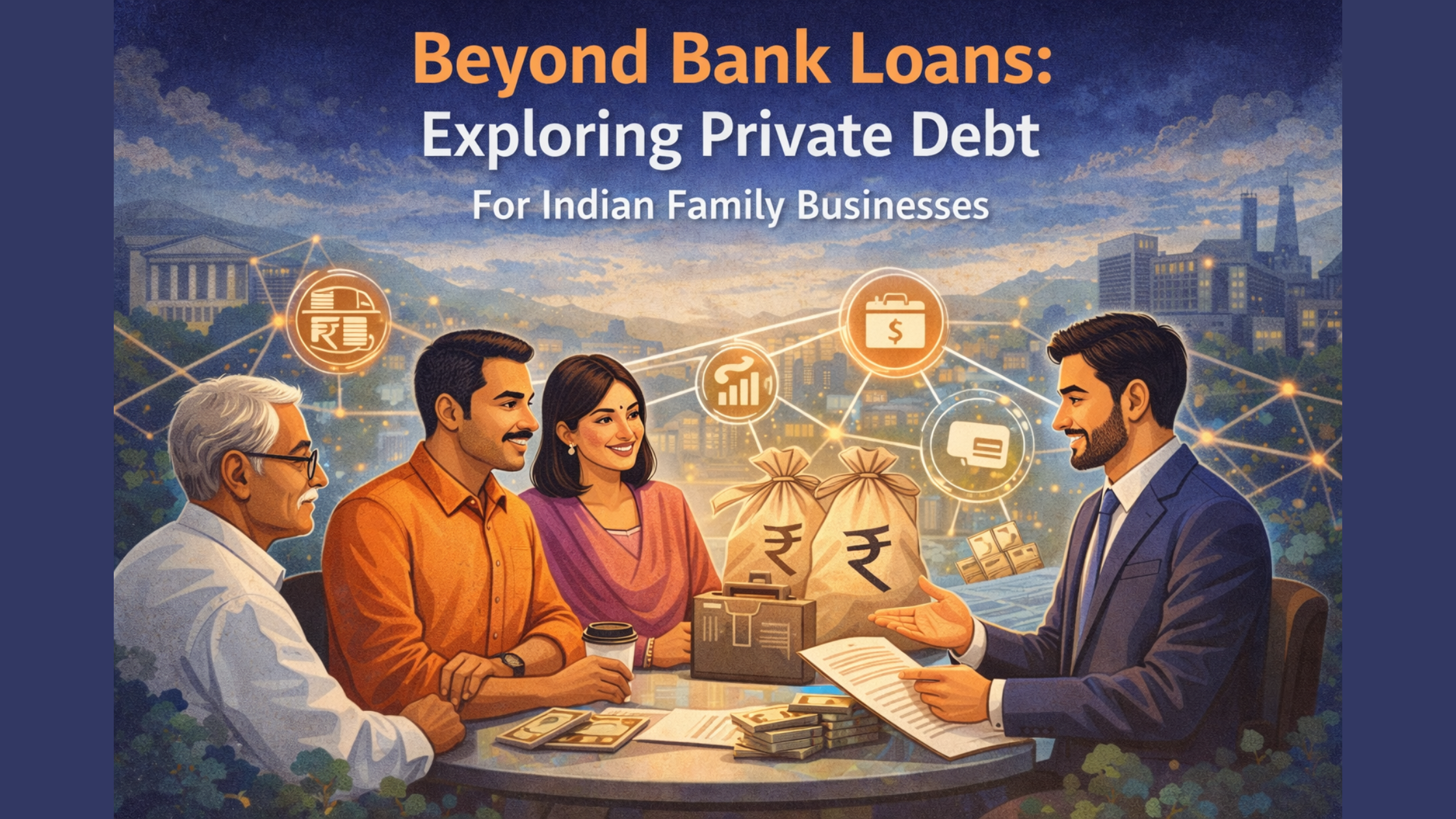
- The Private Credit Revolution In India
- Why Family Businesses Are Embracing Private Debt
- The Spectrum Of Private Debt Options
- Revenue-Based Financing (RBF)
- Invoice Financing And Factoring
- Asset-Based Lending
- Mezzanine Financing
- Sector-Wise Opportunities
- Overcoming Traditional Banking Limitations
- The Cost-Benefit Analysis
- Interest Rate Comparison:
- Value Proposition:
- Regulatory Landscape And Future Outlook
- Strategic Considerations For Family Businesses
- Implementation Strategies
- The Future Of Private Debt For Family Businesses
- Sector-Specific Applications
- Risk Management And Mitigation
- Building Sustainable Relationships
- The Paradigm Shift
- 1. What is private debt financing?
- 2. How is private debt different from bank loans?
- 3. Why do family businesses use private debt?
- 4. Does private debt dilute business ownership?
- 5. Is private debt more expensive than bank financing?
- 6. When should a business consider private debt?
- Conclusion: Embracing The Private Debt Advantage
The Indian financing landscape is shifting as family businesses increasingly embrace private debt over traditional bank loans. With India’s private credit market projected to reach $70 billion by 2028, these enterprises are utilizing flexible options like Revenue-Based Financing (RBF), Mezzanine debt, and Invoice Factoring to fuel growth without diluting equity. Unlike rigid banking structures, private debt offers speed and customization, which is essential for succession planning and rapid expansion. While interest rates are higher, the benefits of control preservation and capital access make private debt a strategic tool for manufacturers and retailers aiming for institutional-level scaling.
The landscape of business finance consulting services in India is undergoing a fundamental transformation. While traditional bank loans have long been the cornerstone of business funding, Indian family businesses are increasingly turning to private debt solutions to fuel their growth ambitions. With India’s private credit market reaching $25 billion in assets under management in 2024 and projecting growth to $60-70 billion by 2028, the time has never been more opportune for family enterprises to explore these alternative financing avenues.
The Private Credit Revolution In India
Private credit represents non-bank lending provided by asset managers, private debt funds, and specialized financial institutions. Unlike traditional banking, private credit offers tailored solutions with flexible structures, making it particularly attractive for family businesses that often struggle with the rigid requirements of conventional lenders.
The numbers tell a compelling story: India’s private credit market has experienced 10x growth from 2012 to 2024, transforming from a niche market of $500-600 million to a robust $10 billion annual deal market. This explosive growth has made India the APAC leader in private credit, with deals witnessing a 22.4% increase in value during the first half of FY 2024-25.
Why Family Businesses Are Embracing Private Debt
Indian family businesses, which contribute 79% of the national GDP, face unique challenges that make private debt an attractive proposition. These challenges create perfect conditions for alternative financing solutions:
- Succession Planning Gaps: With only 21% of Indian family businesses having documented succession plans, many face capital constraints during transition periods. Private debt provides the flexibility needed to navigate these critical phases without compromising family control.
- Growth Capital Requirements: Traditional banks often shy away from financing expansion plans, acquisitions, or working capital needs of family businesses due to perceived risks. Private credit fills this gap by offering growth capital, refinancing options, and acquisition financing.
- Speed and Customization: Family businesses often need quick access to capital for time-sensitive opportunities. Private debt providers can deliver funding within weeks rather than months, with terms tailored to specific business cycles.
The Spectrum Of Private Debt Options
Revenue-Based Financing (RBF)
Revenue-Based Financing has emerged as a game-changer for cash-flow-positive family businesses. The global RBF market, valued at $6.4 billion in 2023, is projected to reach $178.3 billion by 2033 with a CAGR of 39.4%. In India, RBF offers:
- No equity dilution: Family ownership remains intact
- Revenue-linked repayments: Payments fluctuate with business performance
- Flexible terms: Repayment caps typically range from 1.5 to 3 times the funded amount
Companies like Efficient Capital Labs and Klub are leading the RBF revolution in India, providing funding from ₹10 lakhs to ₹50 crores based on revenue visibility.
Invoice Financing And Factoring
For family businesses with strong B2B receivables, invoice financing presents an immediate liquidity solution. This involves:
- Invoice discounting: Borrowing against outstanding invoices while retaining control
- Invoice factoring: Selling invoices to a third party for immediate cash
- Trade receivables financing: Unlocking working capital from unpaid customer invoices
State Bank of India’s MSME Sahaj program exemplifies how traditional banks are adapting, offering unsecured loans against invoices to unlock cash flow.
Asset-Based Lending
Family businesses often possess substantial physical assets that can serve as collateral for financing. Asset-based lending options include:
- Loan Against Property: Using commercial or industrial property for high-ticket capital
- Equipment Financing: Leveraging owned machinery for growth capital
- Inventory Financing: Accessing funds based on stock value
Banks like SBI and Bank of India offer asset-backed loans ranging from ₹10 lakhs to ₹20 crores, with tenures up to 15 years.
Mezzanine Financing
Mezzanine financing occupies the sweet spot between debt and equity, offering family businesses:
- Subordinated debt with equity-like returns for lenders
- Flexible repayment structures, including payment-in-kind options
- Retention of control while accessing growth capital
- Interest rates typically range from 12-20%
Successful examples include Piramal Capital’s investment in Green Infra Limited and Fairfax India’s $300 million investment in Sanmar Chemicals Group.
Sector-Wise Opportunities
Private credit deployment varies significantly across sectors, creating distinct opportunities for family businesses:
| Sector | Share of Private Credit Deals | Key Opportunities |
| Real Estate | 28.3% | Development financing, refinancing |
| Utilities & Infrastructure | 26.4% | Project financing, last-mile funding |
| Renewable Energy | 15.0% | Green transition, equipment financing |
| Healthcare & Pharma | 12.0% | Expansion, R&D funding |
| Financial Services | 10.0% | NBFC funding, fintech growth |
| Industrial/Mining | 8.3% | Capacity expansion, modernization |
Overcoming Traditional Banking Limitations
Family businesses have historically faced several challenges with traditional banking:
- Regulatory Constraints: Banks face mounting regulatory pressures that restrict lending to certain sectors. Private credit providers operate with greater flexibility, addressing financing needs that banks cannot fulfill.
- Collateral Requirements: Traditional banks often demand extensive collateral and personal guarantees. Private credit solutions like RBF eliminate these requirements, focusing instead on business fundamentals and cash flows.
- Credit Rating Dependencies: Many family businesses lack formal credit ratings or fall below bank thresholds. Private credit funds can serve non-rated or lower-rated entities with customized risk assessment.

The Cost-Benefit Analysis
While private debt typically costs more than traditional bank loans, the benefits often justify the premium:
Interest Rate Comparison:
- Traditional bank loans: 10-15% per annum
- Private credit: 12-18% per annum
- Revenue-based financing: 12-15% flat fees
- Mezzanine financing: 12-20% plus equity upside
Value Proposition:
- Speed: Funding in days/weeks vs. months
- Flexibility: Customized terms vs. standardized products
- Access: Available when banks say no
- Control: Minimal interference in business operations
Regulatory Landscape And Future Outlook
The regulatory environment is becoming increasingly supportive of private credit growth:
- SEBI Framework: Most private credit platforms operate as Category II Alternative Investment Funds (AIFs), providing access to both domestic and international capital.
- Policy Support: Government initiatives like GIFT City financial hub offer light-touch regulation and efficient structuring options for private credit funds.
- Infrastructure Development: Reforms like the Insolvency and Bankruptcy Code (IBC) have improved the credit environment, making private credit more viable.
Strategic Considerations For Family Businesses
When evaluating private debt options, family businesses should consider:
Business Stage Alignment: Different financing options suit different business stages:
- Early growth: Revenue-based financing
- Expansion phase: Mezzanine financing
- Working capital needs: Invoice financing
- Asset-heavy operations: Asset-based lending
Cash Flow Compatibility: Revenue-based financing works best for businesses with predictable cash flows, while asset-based lending suits companies with valuable collateral.
Control Preservation: Private debt options like RBF and asset-based lending preserve family control while providing necessary capital.
Implementation Strategies
- Due Diligence Process: Family businesses should:
- Evaluate multiple private debt providers
- Compare terms, rates, and flexibility
- Understand repayment structures thoroughly
- Assess impact on business operations
- Professional Guidance: Given the complexity of private debt structures, engaging financial advisors familiar with alternative financing is crucial for optimal decision-making.
- Gradual Adoption: Many family businesses start with smaller private debt facilities to build relationships and understand the dynamics before scaling up.
The size of the funding requirement matters when assessing whether institutional private credit is appropriate. EY’s H1 2026 report found that transactions valued between US$10 million and US$60 million represented 87% of deal count and 61% of private-credit deal value, up from 51% of deal value in H2 2025. These figures relate to transactions above US$10 million tracked by EY, not to all SME loans. Family businesses should therefore compare their capital requirement with a lender’s typical transaction size before investing time in negotiations.
The Future Of Private Debt For Family Businesses
The trajectory for private debt in India’s family business sector looks exceptionally promising:
- Market Growth: With 15-16% growth in 2024 and forecasted growth of 25-30%, the private credit market offers expanding opportunities.
- Product Innovation: New structures like sustainability-linked financing and blockchain-integrated contracts are emerging to meet evolving business needs.
- Increased Competition: Growing investor interest is driving better terms and more options for borrowers, making private debt increasingly attractive.
Sector-Specific Applications
- Manufacturing: Private credit supports capacity expansion, modernization, and working capital needs that traditional banks often avoid due to cyclical nature.
- Technology Services: Revenue-based financing aligns perfectly with SaaS and subscription-based models prevalent in family-owned tech businesses.
- Healthcare: Private debt enables the expansion of healthcare infrastructure and acquisition of medical equipment without equity dilution.
Risk Management And Mitigation
While private debt offers numerous advantages, family businesses must manage associated risks:
- Higher Costs: Private debt typically costs 2-5% more than bank loans, requiring careful cost-benefit analysis.
- Covenant Structures: Understanding repayment terms and potential penalties is crucial for avoiding financial strain.
- Market Volatility: Economic downturns can affect repayment capacity, making flexible structures essential.

Building Sustainable Relationships
Success with private debt often depends on building long-term relationships with providers:
- Performance Transparency: Maintaining open communication about business performance builds trust and can lead to better future terms.
- Professional Management: Private debt providers increasingly value professional management and governance structures.
- Growth Documentation: Demonstrating consistent growth and strategic vision enhances credibility with alternative lenders.
The Paradigm Shift
The shift toward private debt represents more than just an alternative funding source—it signals a fundamental change in how Indian family businesses approach growth financing. Unlike traditional banking relationships built on assets and guarantees, private debt partnerships focus on business potential and cash flow generation.
This evolution is particularly significant given that family businesses are increasingly open to professional management and external partnerships. With 95% of Indian entrepreneurs who inherited their business feeling trusted by previous generations, there’s unprecedented openness to innovative financing structures.
FAQs
1. What is private debt financing?
Private debt financing refers to loans provided by private lenders or funds instead of traditional banks to businesses seeking capital.
2. How is private debt different from bank loans?
Bank loans come from banks with stricter regulations, while private debt offers more flexible funding structures and faster access to capital.
3. Why do family businesses use private debt?
Family businesses often use private debt to raise growth capital, expand operations, or fund acquisitions without giving up ownership.
4. Does private debt dilute business ownership?
No. Private debt is a loan structure, so owners retain full equity and control of the business.
5. Is private debt more expensive than bank financing?
In many cases, private debt may have higher interest rates due to flexible terms and faster approvals.
6. When should a business consider private debt?
Businesses may consider private debt when bank financing is limited, slow, or insufficient for their growth plans.
Conclusion: Embracing The Private Debt Advantage
For Indian family businesses, private debt represents a strategic opportunity to accelerate growth while maintaining control and flexibility. With India potentially accounting for 30% of private credit fundraising by 2025, early adopters will benefit from better terms, stronger relationships, and competitive advantages.
The key to success lies in matching the right private debt instrument to specific business needs and growth stage. Whether it’s revenue-based financing for cash-flow positive businesses, mezzanine financing for expansion plans, or asset-based lending for capital-intensive operations, private debt offers solutions that traditional banking cannot match.
The future belongs to family businesses that embrace financial innovation while preserving their core values. Private debt provides the perfect bridge—offering institutional-quality capital with family-friendly flexibility. As India’s economic transformation accelerates, family businesses armed with alternative financing options will be best positioned to capitalize on emerging opportunities and build lasting legacies.
The question isn’t whether to explore private debt, but rather which combination of private debt instruments will best serve your family business’s unique growth trajectory. The time to act is now, as the private debt market continues its remarkable expansion across India’s dynamic economy.
Also read:
- Private Debt Vs Public Debt: What Should Indian Businesses Choose In 2026?
-
The Role Of An IPO Consultant In Transitioning Family-Owned Businesses To Public Companies

 Blog
Blog
EBITDA In Banking And NBFCs: Why It Is Not The Right Metric For Every Financial Business
EBITDA in Banking and NBFCs requires a different perspective because traditional EBITDA analysis may not fully reflect how…
Rathandeep U
Read
 Blog
Blog
Healthcare Industry in India: Investment & Growth Opportunities
India’s healthcare sector is entering a new phase of formalisation, consolidation and capital-driven growth. The market is estimated…
Rathandeep U
Read
 Funding your business
How To Write A Business Plan For A Bank Loan
How To Write A Business Plan For A Bank Loan is an essential guide for entrepreneurs seeking business…
Rathandeep U
Read