
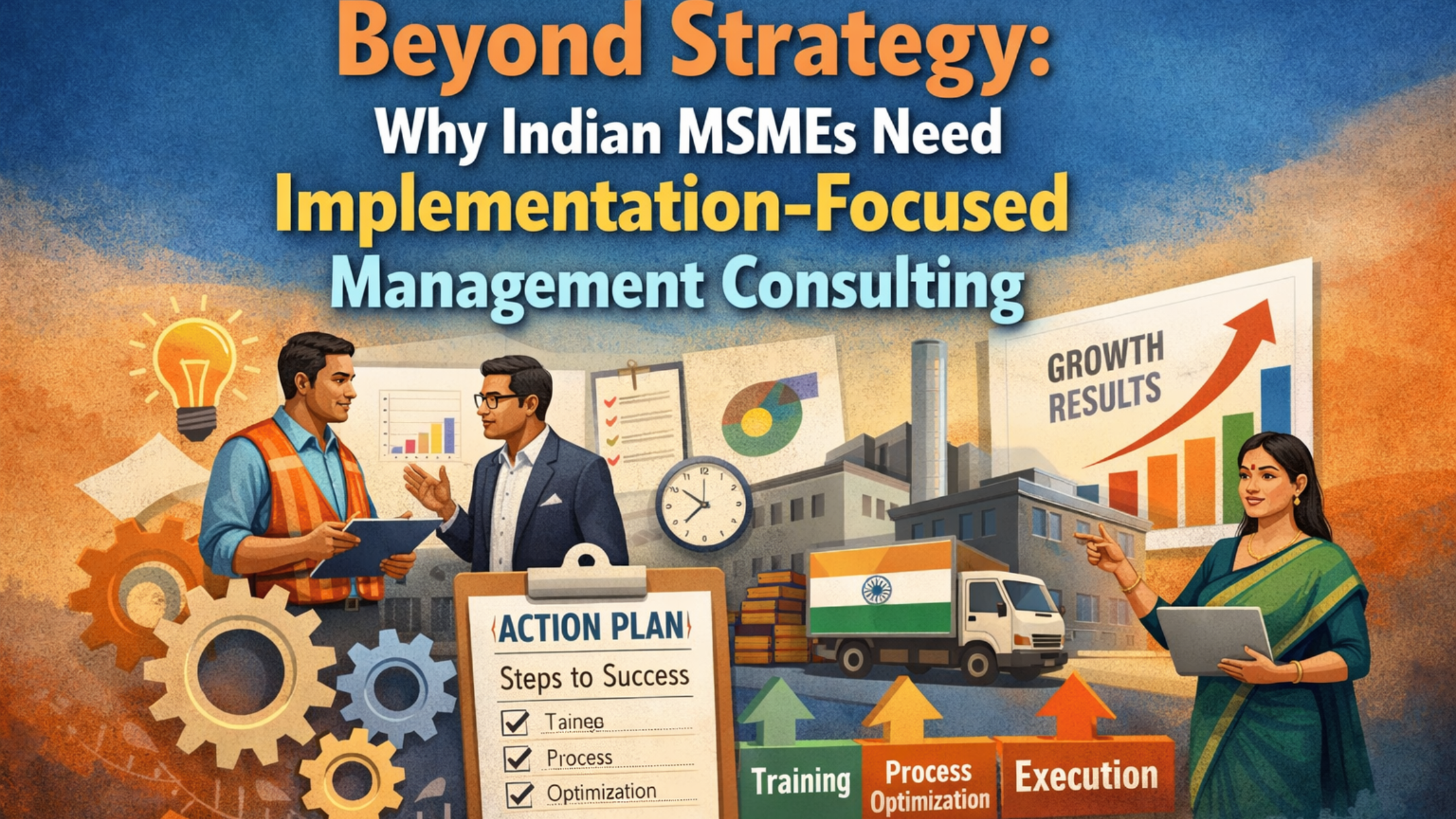

Beyond Strategy: Why Indian MSMEs Need Implementation-Focused Management Consulting
The Indian MSME (Micro, Small, and Medium Enterprises) sector is the engine of the national economy. Founders in this segment are ambitious, resilient, and constantly seeking pathways to scale. When they decide to invest in management consulting, they often secure brilliant, insightful strategies.
The problem? A brilliant strategy is worth nothing if it sits in a binder on the shelf.
For mid-sized firms, the real challenge is not what to do, but how to actually do it. This is why Indian MSMEs need to move beyond strategy and demand consulting partners who are committed to hands-on implementation.
The MSME Implementation Paradox
Why do great strategies often fail to take root in MSMEs, even when the strategy itself is sound?
- Resource Constraints: Unlike large corporations with dedicated Change Management Teams, MSMEs require their existing employees to execute the new strategy on top of their daily operational tasks. Without dedicated implementation support, the new project quickly loses priority.
- Single-Point Dependency: In many family-managed businesses, key knowledge and decision-making authority reside with one or two individuals. A strategy that relies on complex, decentralized structures will collapse without a hands-on guide restructuring those dependencies.
- The “Excel-Only” Legacy: As noted in the concept of “Digital Transformation in Finance,” many MSMEs rely on manual, error-prone systems. A strategy for growth is useless if the underlying accounting, inventory, or billing systems cannot support the change. Implementation requires getting the hands dirty with ERP and automation.
- Cultural Friction: New processes, controls, or governance structures often meet internal resistance. A high-level report cannot overcome years of ingrained habit; only an embedded consultant can drive the necessary cultural shift day-by-day.
The Dangers Of The ‘Strategy-Only’ Trap
Many global consulting firms specialize in high-level diagnostic reports and strategic blueprints. While valuable, this model poses major risks for the MSME founder:
- Zero Ownership: The strategy feels imposed, not owned. Without the consultant driving the initial change, the internal team lacks the confidence or mandate to push it through.
- The Unused Report: The final deliverable becomes an expensive document rather than a living operational guide. The founder has paid for potential, not performance.
- The Mismatch Trap: Strategic recommendations are often designed for large-scale, enterprise resource capacity. When scaled down for an MSME, they are impractical, leading to early failure and budget waste.
The Solution is simple: Demand a partner focused on execution.
The 3 Pillars Of Implementation-Focused Consulting
The best management consulting firms for Indian MSMEs define their success not by the quality of their report, but by the measurability of the operational change.
Pillar 1: Process Co-Creation And Ground-Up Alignment
Implementation begins with humility—understanding that the team knows the business best.
An implementation-focused firm acts as a process co-creator, not a prescriber. They work with mid-management and front-line staff to redesign workflows, build governance mechanisms, and create Standard Operating Procedures (SOPs). This ensures that the new process is not only theoretically sound but also practically workable within the firm’s unique culture.
Pillar 2: Hands-On Technology Integration (From Excel to ERP)
Digital transformation is not a recommendation; it is an installation and training effort.
Whether the strategy involves inventory optimization, financial control, or faster decision-making, it nearly always requires leveraging technology. The implementation consultant is responsible for:
- System Selection: Choosing the right ERP (like Tally, SAP B1, etc.) that fits the MSME budget and complexity.
- Customization and Deployment: Configuring the system to the unique business process, ensuring real-time dashboards and accurate data capture.
- Data Migration: Ensuring a clean and accurate switch from old, manual records to the new system—the most critical point of failure in any tech project.

Pillar 3: Capability Transfer And Long-Term Sustainability
The true measure of a management consultant‘s impact is what the company can achieve after they leave.
Implementation is not complete until the client team has full ownership. This requires the consultant to build internal capability through structured training, mentorship, and the delivery of detailed, practical SOPs. This final step transforms a one-time project cost into a long-term asset by ensuring the changes are sustainable and the team is empowered to manage and evolve the systems independently.
Frequently Asked Questions (FAQ)
1. What is implementation-focused management consulting?
It focuses on executing strategies, not just creating plans—helping MSMEs turn ideas into measurable results.
2. Why do Indian MSMEs need this approach?
Many MSMEs know what to do but struggle with how to do it. Execution gaps slow growth.
3. How is it different from traditional consulting?
Traditional consulting gives advice; implementation-focused consulting works alongside teams to deliver outcomes.
4. What business areas does it help with?
Operations, process improvement, financial controls, growth execution, and performance tracking.
5. Who should opt for this consulting?
MSME owners facing stalled growth, operational inefficiencies, or execution challenges.
6. Is it suitable for small businesses?
Yes. Engagements are scalable and designed for MSME realities and budgets.
7. How soon can results be seen?
Some improvements appear in weeks; sustainable impact builds over months.
8. Does it include team involvement?
Yes. Success depends on hands-on execution, accountability, and team alignment.
Conclusion: Investing In Change, Not Just Advice
For the ambitious MSME founder, choosing a management consulting partner must be an investment in change management and implementation.
Don’t settle for a strategy on paper. Look for the firm that provides the hands-on, week-by-week support necessary to operationalize your goals—the firm that stays until the new systems are running, the governance is stable, and the entire team is aligned. This is the difference between purchasing an expensive opinion and securing a guaranteed path to sustainable growth.
