
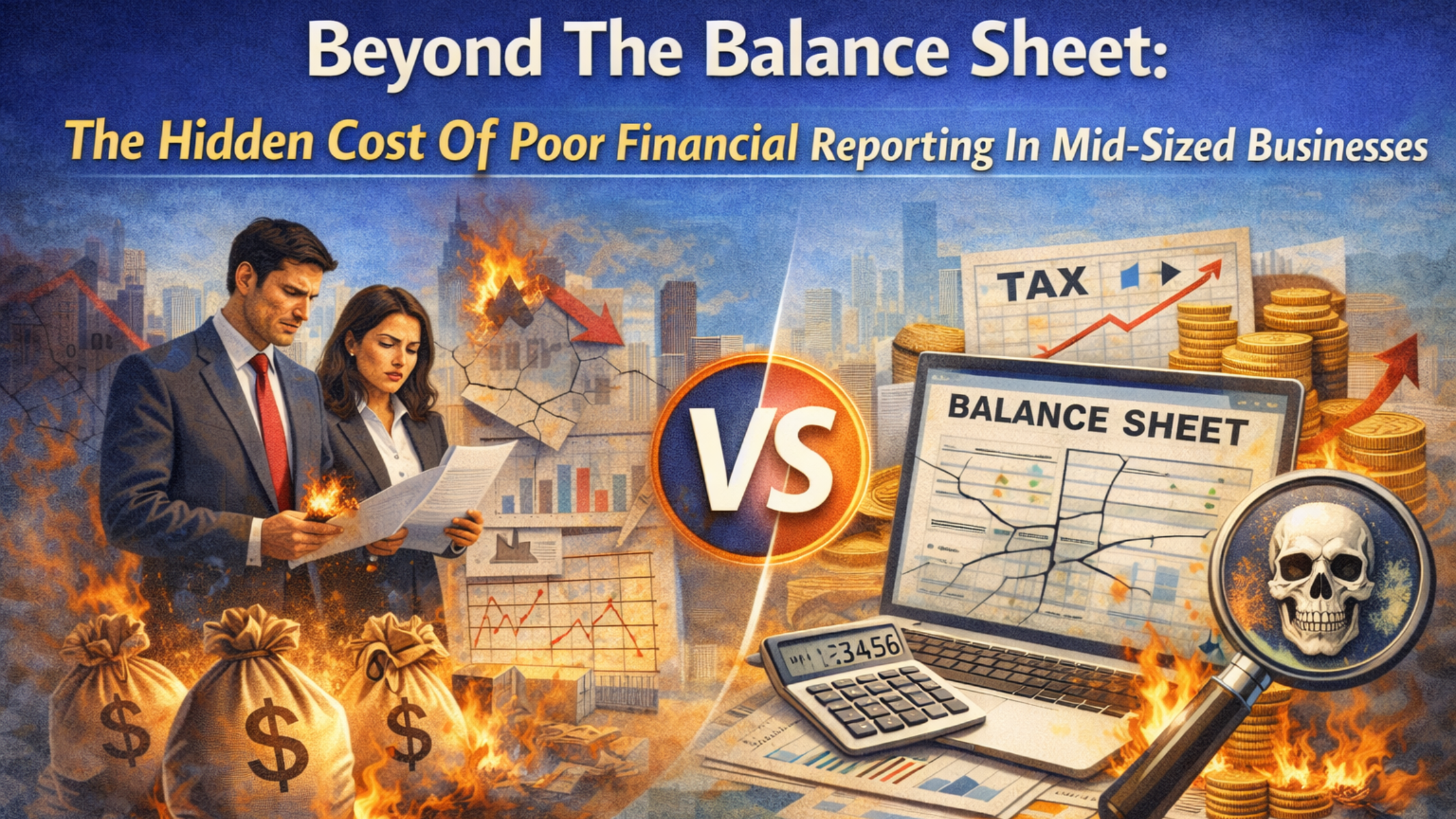

The Hidden Cost Of Poor Financial Reporting In Mid-Sized Businesses
For many mid-sized businesses and family-run enterprises, financial reporting is often viewed through the narrow lens of compliance. It’s seen as something done for the tax authorities or the bank—a “post-mortem” exercise performed long after the month has ended.
However, as a business scales from ₹50 crores to ₹500 crores, the stakes change. At this level, poor financial reporting isn’t just a clerical error; it’s a silent value killer. When your Management Information System (MIS) is inaccurate, the costs are rarely visible on the surface, but they bleed the company dry through bad decisions and lost opportunities.
The “Broken Altimeter” Effect: Bad Decisions
Imagine flying a plane where the altimeter shows you are at 5,000 feet, but you are actually at 500. You would make decisions—like descending—that lead to a crash.
In business, MIS reporting is your altimeter.
- Skewed Margins: If your MIS fails to capture indirect costs or true COGS (Cost of Goods Sold), you might be aggressively pushing a product that is actually losing money.
- Expansion Traps: We often see companies expand into new territories based on “top-line” growth, only to realize six months later that the increased overheads have wiped out their cash reserves.
- Inventory Bloat: Inaccurate reporting often masks “dead stock,” tying up working capital that could have been used for R&D or marketing.
Without real-time, accurate data, leadership is forced to manage by “gut feel”—a strategy that works for a startup but fails for a scaling mid-market firm.
The Erosion Of Investor And Lender Trust
If you are planning an SME IPO or seeking Private Equity (PE) investment, your financial reports are your resume.
Investors don’t just look at how much profit you made; they look at how you arrived at that number. * The Valuation Haircut: When an investor’s due diligence team finds discrepancies between your MIS and your audited books, it creates a “trust deficit.” This usually leads to a significant “haircut” on your valuation.
- The “Uninvestable” Tag: If your reporting is consistently messy, investors may walk away entirely, fearing that there are deeper, hidden liabilities.
- Debt Challenges: Banks are becoming increasingly sophisticated. If your debt-service coverage ratio (DSCR) is calculated on flawed data, you risk a sudden recall of credit lines or increased interest rates.
Operational Leaks And Compliance Risks
Poor reporting often acts as a cloak for operational inefficiencies. When numbers aren’t tracked at a granular level, “leakages”—whether through procurement fraud, wasteful spending, or tax non-compliance—go unnoticed.
In the Indian context, with the increasing integration of GST, IMS, and Income Tax portals, data mismatches can trigger automated notices and heavy penalties, further draining the company’s resources.

Bridging The Gap: Strategy Meets Compliance
In a hub like Tamil Nadu, where the manufacturing and service sectors are growing at a rapid pace, the demand for professionalized finance functions has never been higher.
Many founders start by looking for the best CA firms in Chennai to ensure their statutory compliance is rock-solid. This is an essential first step. However, to turn financial data into a growth engine, businesses need to go beyond just “accounting.”
This is where strategic intervention becomes necessary. To transform “dead data” into “actionable insights,” many successful entrepreneurs partner with the best management consultant in Chennai to build robust MIS frameworks, implement ERP systems correctly, and establish a “Boardroom” culture of accountability.
Frequently Asked Questions (FAQ)
1. What is financial reporting?
Financial reporting shows a company’s financial performance through statements like the balance sheet, income statement, and cash flow statement.
2. Why is accurate financial reporting important?
It helps businesses make informed decisions, manage cash flow, and maintain investor and lender confidence.
3. What are the hidden costs of poor financial reporting?
Hidden costs include wrong decisions, cash flow issues, compliance risks, higher operating costs, and loss of trust.
4. Why are mid-sized businesses more vulnerable?
They often lack strong systems or senior financial oversight, increasing the risk of reporting gaps.
5. How can businesses improve financial reporting?
By strengthening controls, using proper tools, reviewing reports regularly, and seeking expert support.
Conclusion: Your Finance Function Is A Profit Center
Mid-sized businesses can no longer afford to treat the finance department as a “back-office” cost center. Accurate, timely, and transparent financial reporting is the foundation of institutionalized growth.
If you want to save your business from the “hidden costs” of bad data, start by fixing your reporting today. Don’t just record the past—use your numbers to design your future.
