
- 1) The Investor’s Lens: Trust Over Turnover
- 2) The Power Of Independent Directors
- 3) The Audit Committee: Guarding The Integrity Of Data
- 4) ESG Transparency: The New Standard For Capital
- 5) Transitioning From "Founder-Led" To "Board-Governed"
- FAQs: Corporate Governance For SMEs
- 1. What is corporate governance in SMEs?
- 2. Why do investors care about board structure?
- 3. Do SMEs really need a board of directors?
- 4. What are independent directors?
- 5. How does governance help SMEs raise funding?
- Conclusion: Governance As A Competitive Advantage
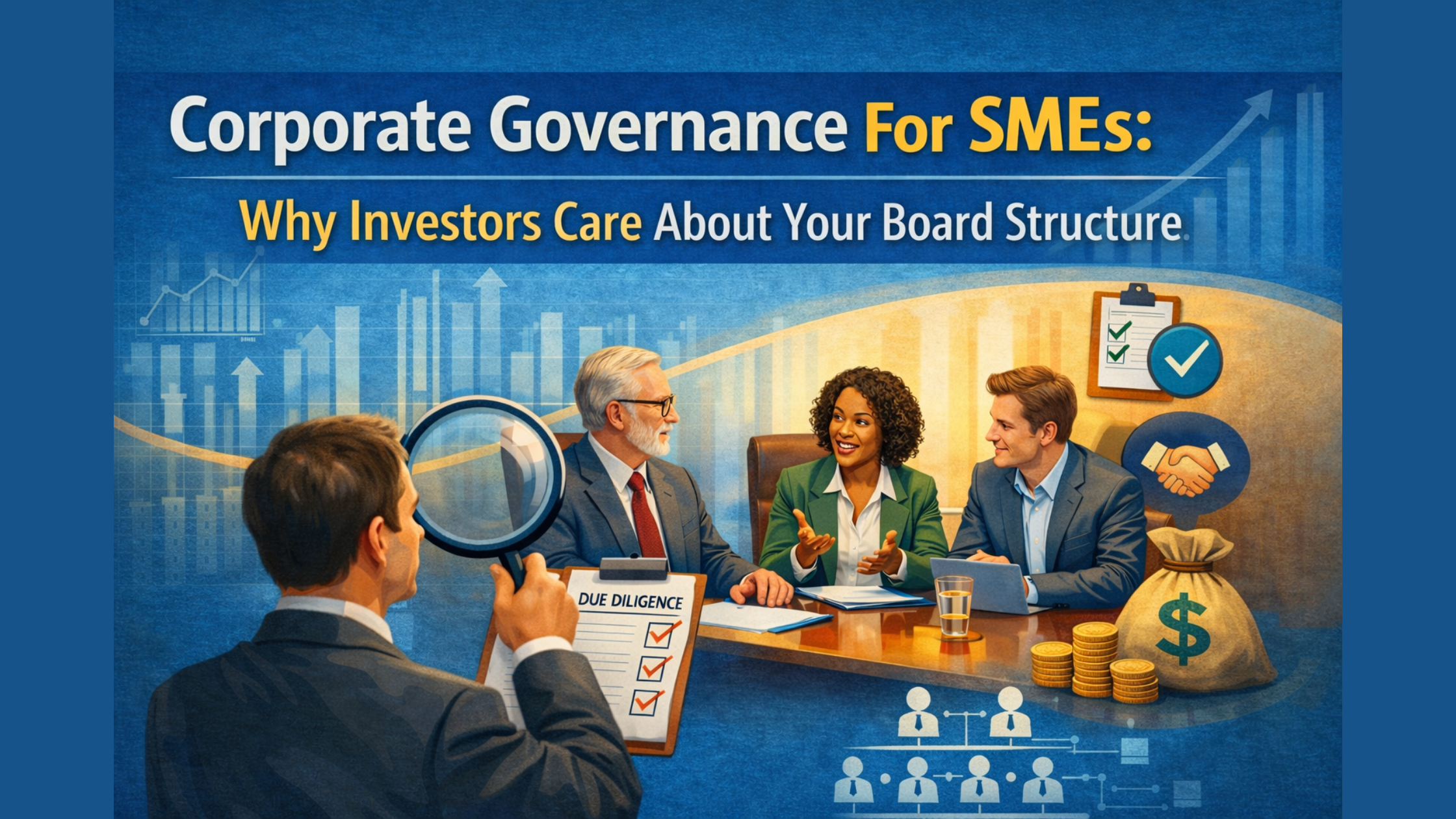
Corporate governance for SMEs is essential for building transparency, accountability, and long-term sustainability. This blog explains how structured governance practices—such as clear roles, ethical decision-making, compliance, and risk management—help SMEs gain investor trust and improve operational efficiency. It highlights the importance of strong leadership, internal controls, and regulatory adherence in scaling businesses. By adopting effective corporate governance, SMEs can enhance credibility, attract funding, and ensure sustainable growth in a competitive business environment.
For many Small and Medium Enterprises (SMEs) in India, “Corporate Governance” sounds like a term reserved for the giants of the Nifty 50. When you are busy managing supply chains, meeting sales targets, and juggling cash flow, the idea of formal board meetings and independent directors can feel like unnecessary bureaucracy.
However, as you look toward the next stage of growth—whether that is a private equity infusion, a strategic partnership, or an SME IPO—the narrative changes. To an investor, your board structure is the ultimate signal of how “safe” and “scalable” your business truly is.
Here is why investors care about your governance framework and how you can professionalize it to attract premium valuations.
1) The Investor’s Lens: Trust Over Turnover
An investor isn’t just buying your current profits; they are buying the reliability of your future earnings. In a founder-led SME, the biggest risk is “Key Person Dependency.” If all decisions are made around a dining table rather than a boardroom, the business is seen as high-risk.
Formal corporate governance proves that the business has a “system” that survives the individual. It demonstrates that you are ready to be accountable to outside capital.
2) The Power Of Independent Directors
One of the first things a Corporate Finance Consulting Firm will suggest during an IPO readiness check is the appointment of Independent Directors.
- Unbiased Perspective: They bring an “outside-in” view, challenging the status quo and preventing “groupthink” that often plagues family-run boards.
- Expertise Infusion: You can strategically appoint directors with backgrounds in technology, global scaling, or legal compliance to fill gaps in the founder’s skill set.
- Credibility: Having a respected industry veteran on your board acts as a “seal of approval” for institutional investors.
3) The Audit Committee: Guarding The Integrity Of Data
Investors live and die by the numbers. If they cannot trust your financial reporting, they will walk away. A formal Audit Committee is the cornerstone of financial governance.
The committee’s role goes beyond just hiring a CA. It involves:
- Overseeing the internal audit process.
- Ensuring that the Management Information System (MIS) reflects the ground reality.
- Monitoring “Related Party Transactions” (RPTs)—a major red flag for investors in the SME sector.
By having a structured committee, you tell the market that your numbers are not just “compliant” but “transparent.”

4) ESG Transparency: The New Standard For Capital
Environmental, Social, and Governance (ESG) is no longer a luxury. Modern investors—especially global PE funds and impact investors—are increasingly filtering companies based on their ESG footprint.
- Environmental: How are you managing waste or energy efficiency?
- Social: Are your labor practices ethical and your workplace safe?
- Governance: Is your decision-making transparent?
SMEs that voluntarily adopt ESG transparency early on often find it easier to access lower-cost debt and attract “patient capital” that seeks long-term sustainability over short-term gains.
5) Transitioning From “Founder-Led” To “Board-Governed”
Professionalizing your board doesn’t mean the founder loses control; it means the founder gains a partner in growth.
In the vibrant business ecosystem of South India, many entrepreneurs are seeking out the best management consultant in Chennai to help them navigate this transition. A consultant doesn’t just provide a report; they help you identify the right board members, set up the charter for committees, and train the internal team on reporting standards.
Partnering with experienced Corporate Finance Consulting Firms ensures that your governance structure is built for the “future you,” not just the “current you.”
FAQs: Corporate Governance For SMEs
1. What is corporate governance in SMEs?
Corporate governance is the system of rules and processes used to manage and control a business. It defines the roles of the board, management, and shareholders to ensure transparency, accountability, and better decision-making.
2. Why do investors care about board structure?
Investors review board structure to understand how well a company is governed. A strong board with experienced members signals better oversight, lower risk, and stronger strategic direction.
3. Do SMEs really need a board of directors?
Yes. Even SMEs benefit from a formal or advisory board as it improves strategic planning, decision-making, and credibility with investors and lenders.
4. What are independent directors?
Independent directors are board members not involved in daily operations. They provide unbiased guidance and strengthen transparency and governance.
5. How does governance help SMEs raise funding?
Good governance builds investor trust by improving transparency, financial discipline, and accountability, making it easier for SMEs to attract funding.
Conclusion: Governance As A Competitive Advantage
In a crowded market, good governance is a differentiator. It lowers your cost of capital, attracts better talent, and prepares you for the rigorous scrutiny of the public markets.
If you want to move from being a “successful business” to an “institutionalized brand,” your board structure is the best place to start. Stop viewing governance as a compliance hurdle and start seeing it as your most powerful fundraising tool.
Looking to professionalize your board or prepare for an IPO?
At Consulting & Beyond, we specialize in helping Indian MSMEs bridge the gap between entrepreneurship and institutional excellence.

2 thoughts on “Corporate Governance For SMEs: Why Investors Care About Your Board Structure”
 Blog
Blog
EBITDA In Banking And NBFCs: Why It Is Not The Right Metric For Every Financial Business
EBITDA in Banking and NBFCs requires a different perspective because traditional EBITDA analysis may not fully reflect how…
Rathandeep U
Read
 Blog
Blog
Healthcare Industry in India: Investment & Growth Opportunities
India’s healthcare sector is entering a new phase of formalisation, consolidation and capital-driven growth. The market is estimated…
Rathandeep U
Read
 Blog
Blog
Feasibility Study In Business: A Complete Guide For Indian SMEs & Family Businesses
A feasibility study is essential for making informed business decisions, especially for Indian SMEs and family-owned businesses. A…
Rathandeep U
Read

[…] statements, statutory compliance, taxation, contracts, customer concentration, litigation, governance, intellectual property, management capability and future projections. Preparing these well before […]
[…] internal controls, maintain accurate financial records, resolve compliance issues, improve corporate governance, and demonstrate a scalable business model. Early preparation can help identify risks, avoid costly […]