
- The Context: Powerful Shifts In SME Finance
- Why Capital Structure Matters More Than Ever
- Building A Smarter Capital Mix
- 1. Prioritize Working-Capital Financing
- 2. Explore Revenue-Based Financing
- 3. Use Equity Wisely
- 4. Consider Hybrid Instruments
- 5. Stress-Test Your Balance Sheet
- The 2026 Action Map For SMEs
- FAQs: Why Indian SMEs Must Rethink Their Capital Structures
- 1. Why should Indian SMEs rethink their capital structure?
- 2. What is capital structure in a business?
- 3. What challenges do SMEs face in accessing capital?
- 4. What funding options can SMEs explore besides bank loans?
- 5. How does the right capital structure benefit SMEs?
- Final Word
The Context: Powerful Shifts In SME Finance
- SMEs contribute ~30% to India’s GDP, yet only 19–25% have access to formal credit sources—even though the financing requirement is vast.
- The SME credit gap stands at ₹2.93–3 lakh crore, while digital lending is surging.
- Traditional bank credit remains sluggish—increased private debt, corporate bond and CP markets are emerging as viable alternatives.
Why Capital Structure Matters More Than Ever
- Rising Interest Costs Demand Balance
Even though the RBI cut interest rates in 2025, many SMEs can’t benefit due to poor access to bank lending. Reliance on high-cost debt can choke liquidity. - Debt Offers Speed, But Equity Brings Stability
With digital lenders and supply-chain financing options, debt is faster—but equity or profit-based models (e.g., revenue-based financing) offer flexibility and lower dilution. - GST & Cash Flow Reforms Change the Game
Post-GST adoption, many profitable SMEs stopped needing short-term debt but continue to struggle with long-term structured financing. - ESG and Policy-Nudge Toward Transparency
With regulations like SEBI’s BRSR and growing investor demand for governance, equity partners and formal structures deliver market confidence.
Building A Smarter Capital Mix
1. Prioritize Working-Capital Financing
- Credit Guarantee Schemes and supply-chain financing give you cheaper access to liquidity vs. long-term debt.
- Smart working capital differentiation preserves cash flow for growth.
2. Explore Revenue-Based Financing
- Non-dilutive and linked to cash flows—ideal for consumption-based SMEs.
- Companies like GetVantage disburse capital based on projected revenues, repaid via royalty-type models.
3. Use Equity Wisely
- If you’re scaling for equity investors or IPO readiness (even SME IPOs), early equity helps build credibility and reserves.
- Ensure equity isn’t just structural—layer strong governance and financial systems around it.
4. Consider Hybrid Instruments
- Options like mezzanine or unitranche debt can blend debt-and-equity benefits—enabling structured, flexible financing with lower dilution.
5. Stress-Test Your Balance Sheet
- Monitor debt-to-equity (D/E) ratios, interest coverage, and free cash flow generation (especially now rates are volatile).
- Avoid excessive leverage seen in over-expanded corporate peers.

The 2026 Action Map For SMEs
| Pillar | Objective | Action Step |
| Working Capital | Liquidity without equity dilution | Use CGTMSE-backed credit or supply-chain financing |
| Repayment-linked Financing | Revenue-aligned commitments | Partner with fintechs like GetVantage |
| Equity / IPO-readiness | Investor alignment & governance | Build internal controls, clean records |
| Hybrid & Structured Instruments | Optimize costs & flexibility | Consider mezzanine or unitranche loans |
| Capital Discipline | Avoid over-leverage risks | Maintain D/E below 1.0; align with cash flow |
FAQs: Why Indian SMEs Must Rethink Their Capital Structures
1. Why should Indian SMEs rethink their capital structure?
Indian SMEs often depend heavily on traditional debt such as bank loans. Diversifying capital sources can improve financial stability and support long-term growth.
2. What is capital structure in a business?
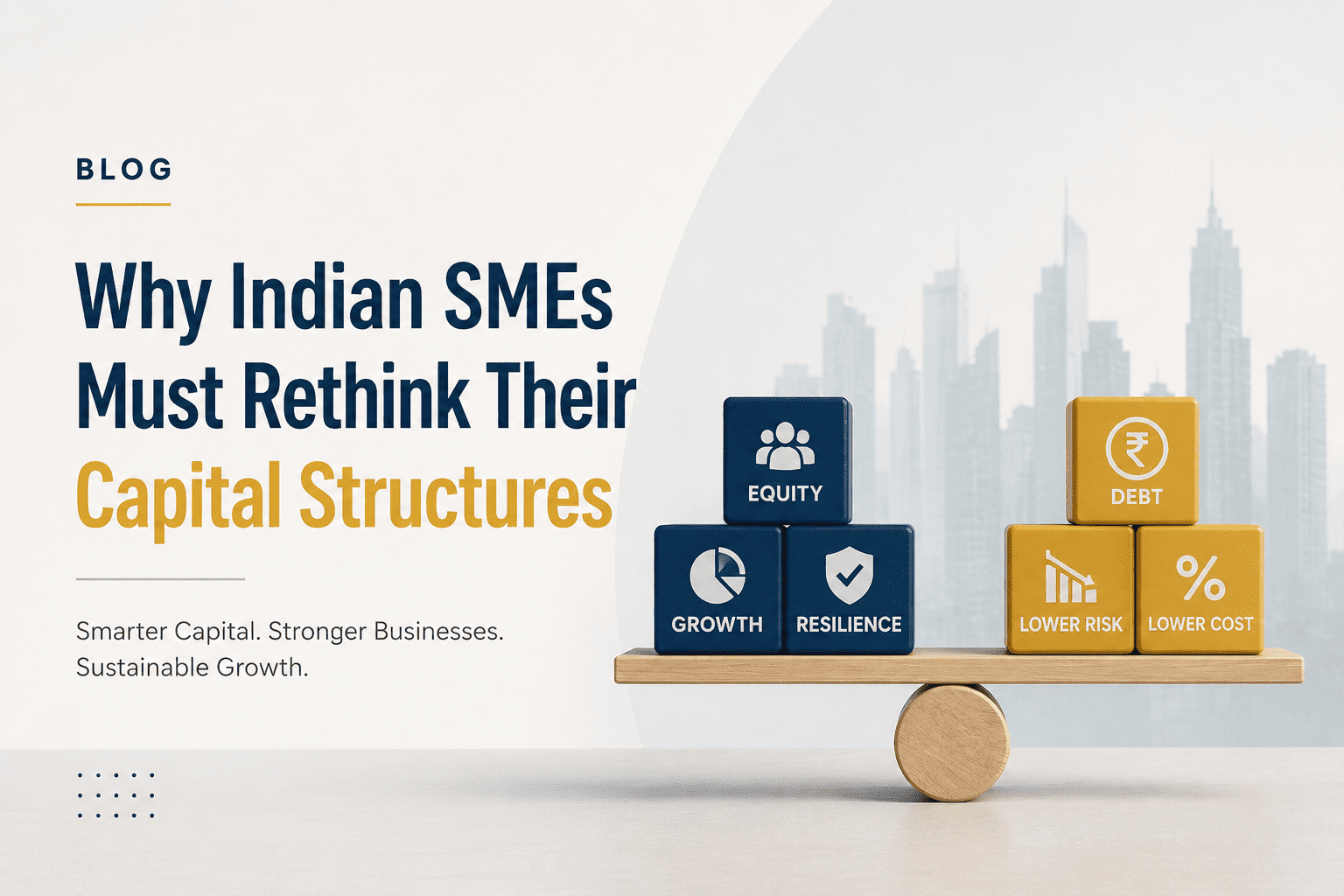
Capital structure refers to the mix of debt and equity a business uses to finance its operations and growth.
3. What challenges do SMEs face in accessing capital?
Many SMEs struggle to access formal credit, even though they contribute around 30% to India’s GDP, highlighting a large financing gap in the sector.
4. What funding options can SMEs explore besides bank loans?
SMEs can consider equity funding, venture capital, private equity, SME IPOs, and alternative financing platforms.
5. How does the right capital structure benefit SMEs?
An optimized mix of debt and equity helps businesses reduce financial risk, improve cash flow management, and fund expansion more effectively.
Final Word
It’s no longer enough to just borrow or issue equity—you must borrow smartly, issue equity strategically, and align all capital to your cash flows.
In an era of ESG norms, digital lending, and investor sophistication, Indian SMEs need capital structures that are agile, credible, and fit for growth.
If you’d like help reviewing your current mix and making it future-proof, reach out. The right structure could define your next growth phase.
Also Read:
- Recent Trends in SME IPO
- Private Debt Vs Public Debt: What Should Indian Businesses Choose In 2026?
- Private Debt for Family Businesses: Beyond Bank Loans
- SME IPO In India: A Complete Beginner’s Guide For Founders
- Leveraging GIFT City (IFSC) For Low-Cost Offshore Funding: How Indian SMEs Can Unlock Global Capital Through IFSC GIFT City

 Blog
Blog
Feasibility Study In Business: A Complete Guide For Indian SMEs & Family Businesses
A feasibility study is essential for making informed business decisions, especially for Indian SMEs and family-owned businesses. A…
Rathandeep U
Read
 Blog
Blog
How To Write A Funding Pitch: A Complete Guide For Indian SMEs & Family Businesses
How to Write a Funding Pitch is an essential skill for Indian SMEs and family businesses seeking investors,…
Rathandeep U
Read
 Blog
Blog
Why Most SME IPOs Fail Before They Even File Their DRHP
Most SME IPO Fails because they begin the IPO journey without adequately preparing their financials, governance, compliance, documentation,…
Rathandeep U
Read