
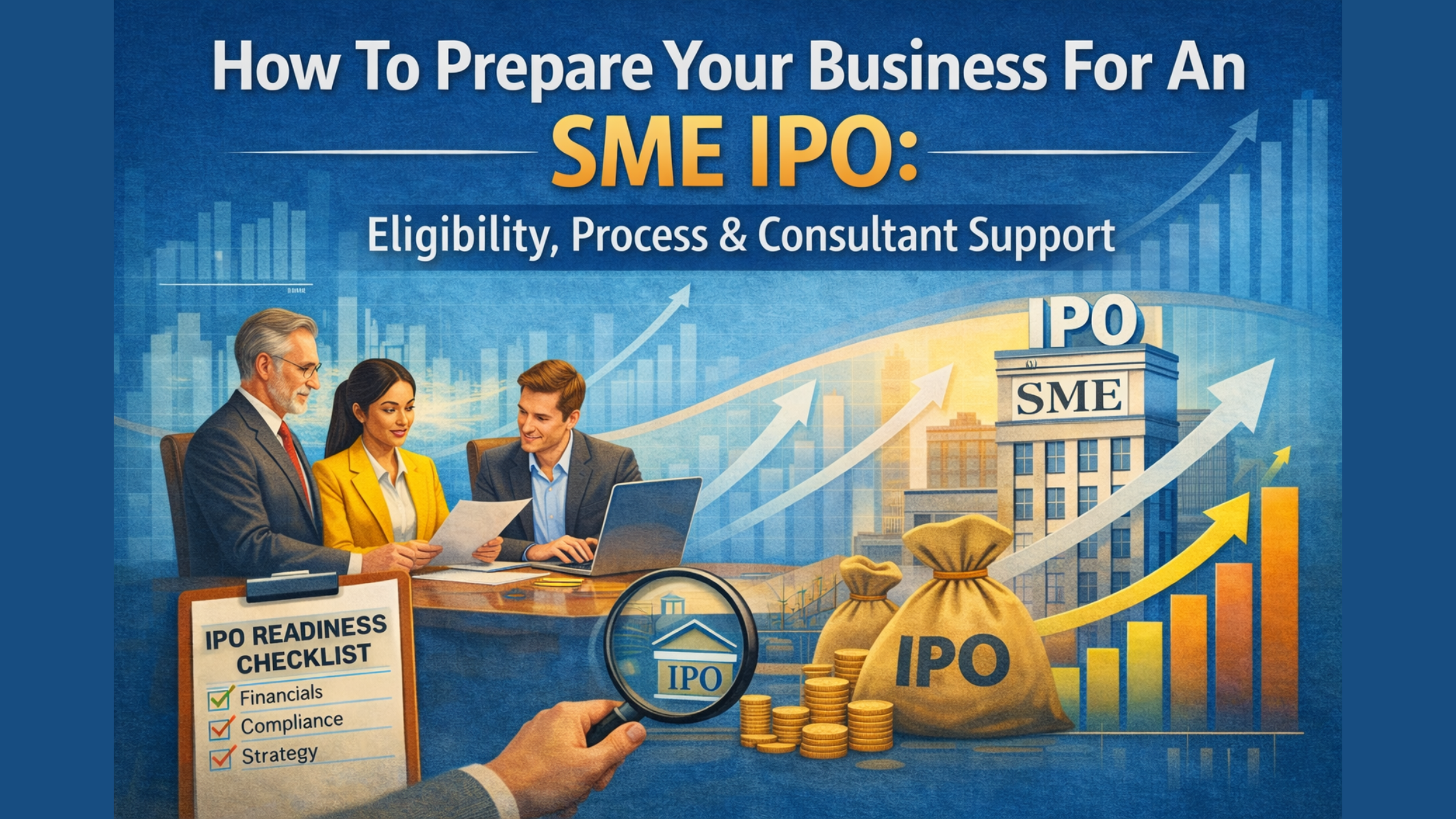
- How To Prepare Your Business For An SME IPO: Eligibility Criteria
- SME IPO Process Steps
- People Also Asked
- 1. What is an SME IPO?
- 2. What are the eligibility requirements for an SME IPO?
- 3. What is the SME IPO process?
- 4. Why do businesses need SME IPO consultants?
- 5. How long does it take to prepare for an SME IPO?
If you’re a founder planning to list your company on an SME exchange in India, it’s crucial to understand the entry criteria and process steps ahead of time. Below is a roadmap covering the key eligibility rules, IPO process stages, common hurdles, and how SME IPO consultants can help guide your business toward a successful listing.
How To Prepare Your Business For An SME IPO: Eligibility Criteria
SME listing rules set minimum requirements to protect investors and ensure readiness. A company must generally meet all of the following before filing:
- Company status: The issuer must be a company incorporated in India (private or public).
- Paid-up capital limit: Its post-issue paid-up equity capital must not exceed ₹25 crore (per SEBI ICDR Reg. 229). (If a company has higher capital, it would need to list on the main board instead.)
- Operating track record: The firm (or its promoters collectively) should have at least 3 years of operating history. This can include a predecessor partnership or LLP’s track record if properly converted into a company with restated financials.
- Profitability: The company should have earned operating profits (EBITDA) of at least ₹1 crore in any two of the last three financial years. This demonstrates viability.
- Financial health: It must show a positive net worth and positive cash flows (free cash flow) in at least 2 of the last 3 years.
- Promoter qualifications: Promoters should have relevant business experience (usually 3+ years in the same industry). If there was a recent change in promoters or new promoters acquired a majority stake, the SME can typically only list after maintaining that structure for one year.
- No insolvency or legal issues: The company and its promoters must not be under any major insolvency resolution, bankruptcy, or NCLT winding-up proceedings, and should have no serious regulatory violations or pending enforcement actions.
- Shareholding rules: Existing shareholders can offer shares to the public (OFS) up to a certain limit (e.g., max 20% of the issue) and no selling shareholder may sell more than 50% of their holding in the IPO. Promoters are generally subject to a lock-in period post-listing (commonly 1 year).
These conditions (drawn from SEBI and exchange guidelines) must all be satisfied. If your company checks these boxes, you are considered eligible to apply for an SME IPO.

SME IPO Process Steps
Once eligibility is confirmed, the IPO process follows several phases:
- Appoint Intermediaries: First, hire a SEBI-registered merchant banker (lead manager) to underwrite the issue. This banker will be your main partner in the IPO. (SME IPOs must be fully underwritten.) You’ll also work with legal counsel, auditors, registrars, and depository participants coordinated by the lead manager.
- Corporate Preparations: Internally, set up any necessary structures: adopt board and shareholder resolutions to authorize the IPO, constitutions (like special committees), and ensure audited financials and corporate governance are in place. Clean up your books, organize restated accounts if coming from a partnership/LLP, and resolve any outstanding issues. The merchant banker will conduct due diligence on your operations and finances.
- Draft the DRHP: Prepare the Draft Red Herring Prospectus (DRHP) with your advisor. This is a comprehensive document describing your business, financial history, promoters, risk factors, and how the new funds will be used. It is a critical piece; accuracy is essential.
- Regulatory Filings: File the DRHP with SEBI and the chosen SME exchange (NSE Emerge or BSE SME). The exchange will vet the DRHP for compliance, and SEBI may also review it. Respond to any queries and incorporate feedback to finalize the Red Herring Prospectus (RHP). Meanwhile, obtain conditional approvals like the Stock Exchange’s in-principle listing approval (LoI).
- Marketing the IPO: Once filings are in order, publicize the issue. Announce the opening and closing dates of the IPO, the price band, and other details. Even though SME IPOs attract mainly institutional and high-net-worth investors, you should still communicate the opportunity clearly. (Roadshows or investor meetings may be smaller in scale than for big IPOs, but they follow the same principle of creating interest.)
- Bidding and Allotment: Launch the IPO for subscription on the scheduled date. Investors place bids (at or above the floor price). After the issue closes, shares are allotted to successful bidders according to SEBI’s book-building or fixed-price allocation process. The merchant banker and registrar coordinate this.
- Listing on the Exchange: Once all shares are allotted, they are credited to investors’ Demat accounts and the company’s shares are officially listed on the SME platform. The listing date is when your shares begin trading. At that point, your firm becomes a public company.
- Post-IPO Compliance: After listing, ensure ongoing obligations are met. SMEs must file periodic reports (quarterly/half-yearly financials, shareholding pattern, corporate announcements), conduct AGM, and comply with SEBI and exchange rules on disclosures and corporate governance.
People Also Asked
1. What is an SME IPO?
An SME IPO allows small and medium businesses to raise capital by listing their shares on SME platforms like BSE SME or NSE Emerge.
2. What are the eligibility requirements for an SME IPO?
Companies generally need a 3-year track record, positive profits, minimum net tangible assets, and post-issue paid-up capital below ₹25 crore.
3. What is the SME IPO process?
The process includes appointing advisors, preparing financial statements, filing the DRHP, getting exchange approvals, opening the issue to investors, and listing the company.
4. Why do businesses need SME IPO consultants?
Consultants help with regulatory compliance, documentation, valuation, and coordinating with merchant bankers and stock exchanges.
5. How long does it take to prepare for an SME IPO?
Preparation for an SME IPO typically takes 6–12 months, depending on financial readiness and regulatory compliance.
This entire journey usually takes about 4–6 months, assuming all approvals proceed smoothly. Careful planning and coordination among your team and intermediaries are key to staying on schedule.

3 thoughts on “How To Prepare Your Business For An SME IPO: Eligibility, Process & Consultant Support”
 Blog
Blog
EBITDA In Banking And NBFCs: Why It Is Not The Right Metric For Every Financial Business
EBITDA in Banking and NBFCs requires a different perspective because traditional EBITDA analysis may not fully reflect how…
Rathandeep U
Read
 Blog
Blog
Healthcare Industry in India: Investment & Growth Opportunities
India’s healthcare sector is entering a new phase of formalisation, consolidation and capital-driven growth. The market is estimated…
Rathandeep U
Read
 Funding your business
How To Write A Business Plan For A Bank Loan
How To Write A Business Plan For A Bank Loan is an essential guide for entrepreneurs seeking business…
Rathandeep U
Read

[…] How To Prepare Your Business For An SME IPO: Eligibility, Process & Consultant Support […]
[…] next stage of growth—whether that is a private equity infusion, a strategic partnership, or an SME IPO—the narrative changes. To an investor, your board structure is the ultimate signal of how […]
Alright, x111gamedownload.com, time to put your downloads to the test! Hope they come with the right files and at good speeds. x111gamedownload