
- What Is A Business Feasibility Study?
- Why Is A Business Feasibility Study Important?
- When Should Businesses Conduct A Feasibility Study?
- Types Of Business Feasibility Studies
- 1. Market Feasibility
- 2. Technical Feasibility
- 3. Financial Feasibility
- 4. Operational Feasibility
- 5. Legal And Regulatory Feasibility
- Key Components Of A Business Feasibility Study
- Executive Summary
- Business Overview
- Market Research
- Technical Assessment
- Financial Analysis
- Risk Assessment
- Common Mistakes Businesses Make
- Benefits For Feasibility Study For SMEs & Family Businesses
- How Banks And Investors Use Feasibility Studies
- Why Professional Business Feasibility Studies Matter
- Frequently Asked Questions (FAQs)
- 1. What is a feasibility study in business?
- 2. Why is a feasibility study important for SMEs?
- 3. What are the main components of a feasibility study?
- 4. How is a feasibility study different from a business plan?
- 5. Who should prepare a feasibility study?
- Conclusion
- Ready To Validate Your Next Business Investment?
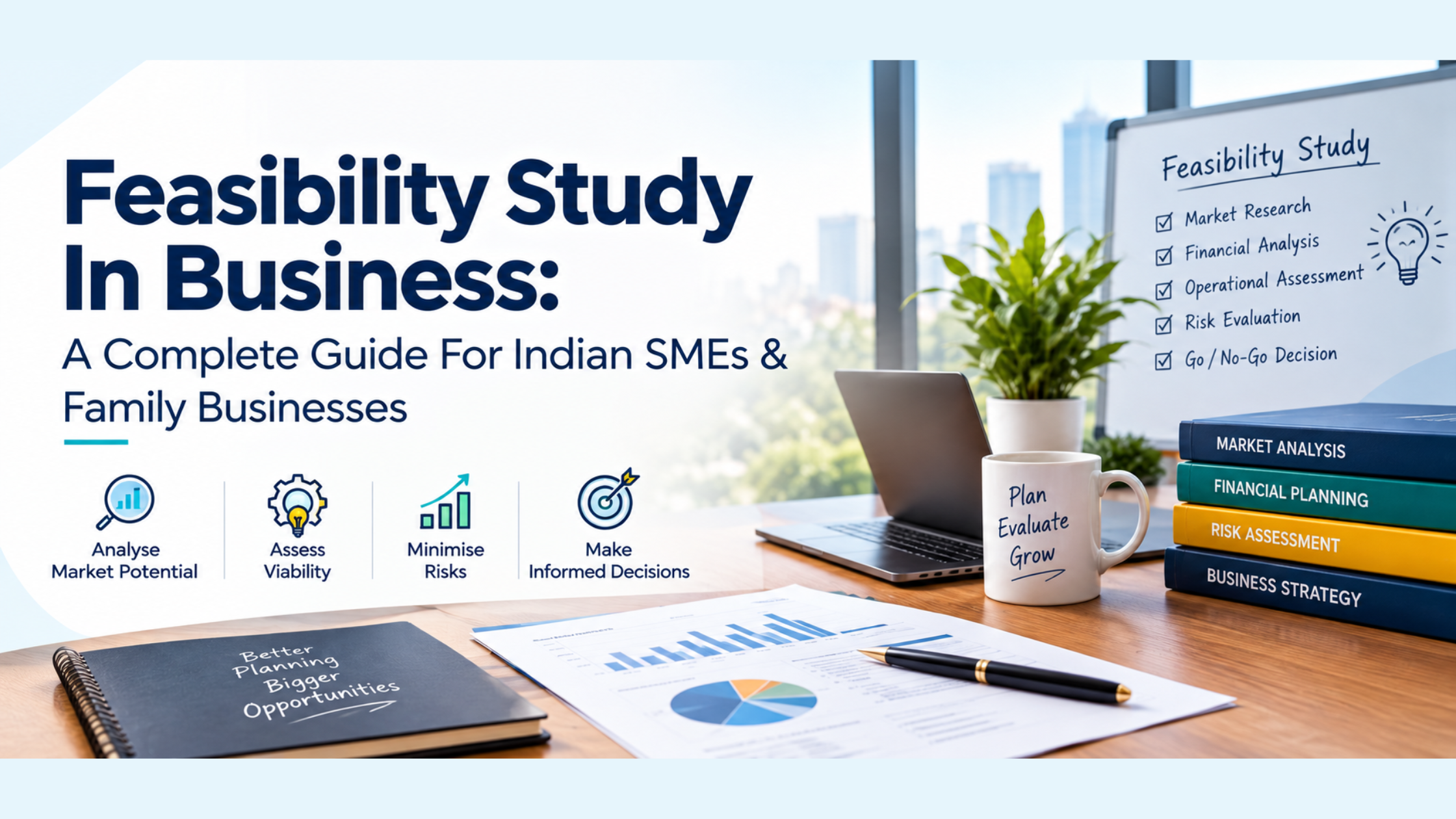
A feasibility study is essential for making informed business decisions, especially for Indian SMEs and family-owned businesses. A Complete Guide For Indian SMEs & Family Businesses explains how feasibility analysis helps evaluate market potential, financial viability, operational requirements, legal considerations, and potential risks before investing resources. The guide highlights the importance of realistic financial projections, market research, cost analysis, and risk assessment when evaluating a new project or business opportunity. By conducting a structured feasibility study, business owners can identify challenges early, minimise investment risks, improve planning, and make confident go-or-no-go decisions. Professional guidance can further strengthen the study’s accuracy and credibility.
Every successful business expansion begins with one critical question: “Is this idea truly viable?” Many businesses invest significant time and money into new projects, products, or expansions without thoroughly evaluating whether the opportunity is commercially, financially, and operationally feasible. The result is often delayed projects, cost overruns, or failed investments.
A feasibility study helps businesses answer this question before making major financial commitments. It enables entrepreneurs to identify risks, estimate returns, validate assumptions, and make informed decisions backed by data rather than intuition.
In this guide, we’ll explore what a feasibility study is, why it matters, its key components, and how Indian SMEs and family businesses can use it to improve decision-making and secure sustainable growth.
What Is A Business Feasibility Study?
A feasibility study is a structured assessment conducted before starting a new project, business, expansion, acquisition, or investment. It evaluates whether the proposed venture is technically possible, financially viable, commercially attractive, legally compliant, and operationally achievable.
Unlike a business plan, which focuses on execution, a feasibility study determines whether the project should proceed in the first place.
It answers one simple question:
“Should we invest in this opportunity?”
Why Is A Business Feasibility Study Important?
Many businesses assume that demand alone guarantees success. However, profitability depends on multiple factors such as project costs, financing, competition, operational capability, regulatory compliance, and market dynamics.
A well-prepared feasibility study helps businesses:
- Reduce investment risks
- Improve decision-making
- Validate business opportunities
- Assess financial viability
- Identify operational challenges
- Strengthen investor confidence
- Improve bank loan approvals
- Support strategic planning
For SMEs and family businesses, it provides confidence before committing valuable capital.
When Should Businesses Conduct A Feasibility Study?
A feasibility study is valuable before making any significant investment, including:
- Starting a new business
- Launching a new product
- Expanding manufacturing capacity
- Opening a new branch or retail outlet
- Entering new domestic or international markets
- Purchasing machinery
- Building a factory or warehouse
- Acquiring another business
- Applying for large bank loans
- Raising equity or private investment
Conducting the study early can prevent expensive mistakes later.
Types Of Business Feasibility Studies
1. Market Feasibility
This assesses whether there is sufficient customer demand for your product or service.
It examines:
- Target customers
- Market size
- Growth trends
- Competition
- Pricing
- Customer preferences
Without market demand, even the best product can struggle to succeed.
2. Technical Feasibility
Technical feasibility determines whether the project can be executed with available technology and resources.
It evaluates:
- Manufacturing processes
- Machinery requirements
- Technology adoption
- Infrastructure
- Skilled workforce
- Production capacity
Operational readiness is essential for long-term success.
3. Financial Feasibility
Financial feasibility assesses whether the project is economically viable.
This includes:
- Project cost
- Capital expenditure
- Working capital requirement
- Revenue projections
- Operating expenses
- Profitability
- Cash flow analysis
- Break-even analysis
- Return on Investment (ROI)
- Debt servicing capacity
Financial feasibility often determines whether banks and investors support a project.
4. Operational Feasibility
This examines whether the business has the capability to manage day-to-day operations.
Key considerations include:
- Organizational structure
- Human resources
- Supply chain
- Inventory management
- Quality control
- SOP implementation
- Vendor network
Operational efficiency significantly influences profitability.
5. Legal And Regulatory Feasibility
Every project must comply with applicable laws and regulations.
Review:
- Company registrations
- Environmental approvals
- Factory licenses
- GST compliance
- Labour laws
- Industry-specific regulations
- Intellectual property requirements
Ignoring compliance can delay projects and increase costs.
Key Components Of A Business Feasibility Study
Executive Summary
Provide a concise overview of the project, objectives, investment requirement, and overall conclusion.
This section should enable decision-makers to quickly understand the opportunity.
Business Overview
Describe:
- Business profile
- Industry
- Products or services
- Existing operations
- Expansion plans
Family businesses should also mention governance and succession planning where relevant.
Market Research
Market analysis should include:
- Industry trends
- Customer demand
- Market segmentation
- Competitor analysis
- Pricing
- Growth opportunities
Reliable market research strengthens project credibility.
Technical Assessment
Explain:
- Plant location
- Capacity planning
- Machinery
- Technology
- Production process
- Utilities
- Infrastructure
Technical planning helps estimate realistic project costs.
Financial Analysis
This is often the most critical section.
Include:
- Project cost estimation
- Sources of funding
- Revenue projections
- Operating costs
- EBITDA projections
- Cash flow forecast
- Balance Sheet projections
- Profit & Loss statement
- Break-even analysis
- Sensitivity analysis
- Debt Service Coverage Ratio (DSCR)
- Internal Rate of Return (IRR)
- Net Present Value (NPV)
These metrics help stakeholders assess the financial strength of the project.
Risk Assessment
Every investment carries risks.
Identify:
- Market risks
- Operational risks
- Financial risks
- Technology risks
- Regulatory risks
- Supply chain risks
More importantly, explain mitigation strategies.
Investors appreciate balanced analysis.
Common Mistakes Businesses Make
Many feasibility studies fail because they rely on unrealistic assumptions.
Avoid:
- Overestimating revenue
- Underestimating project costs
- Ignoring working capital
- Weak market research
- No competitor analysis
- Unrealistic pricing
- Poor financial projections
- Ignoring regulatory approvals
- Lack of contingency planning
Objective analysis is more valuable than optimistic assumptions.

Benefits For Feasibility Study For SMEs & Family Businesses
A feasibility study delivers value beyond funding.
It helps businesses:
- Allocate capital wisely
- Reduce financial risk
- Improve profitability
- Build investor confidence
- Secure bank financing
- Prioritize growth opportunities
- Strengthen governance
- Improve strategic planning
For family businesses, it also supports informed succession and long-term wealth creation.
How Banks And Investors Use Feasibility Studies
Banks, NBFCs, private equity firms, venture capital funds, and strategic investors rely on feasibility studies to assess investment quality.
They review:
- Commercial viability
- Promoter capability
- Financial projections
- Risk profile
- Capital requirement
- Repayment capacity
- Return potential
A professionally prepared feasibility study significantly improves funding credibility.
Why Professional Business Feasibility Studies Matter
Preparing a feasibility study requires more than compiling financial data. It involves evaluating commercial assumptions, conducting market research, building financial models, assessing risks, and recommending the most practical course of action.
Corporate Finance professionals can help businesses:
- Validate project assumptions
- Build realistic financial projections
- Conduct market and industry analysis
- Assess project viability
- Optimize funding requirements
- Improve lender and investor confidence
- Support strategic decision-making
Professional guidance helps ensure that investment decisions are based on facts rather than assumptions.
Frequently Asked Questions (FAQs)
1. What is a feasibility study in business?
A feasibility study is a detailed evaluation of a project’s commercial, technical, financial, operational, and legal viability before implementation.
2. Why is a feasibility study important for SMEs?
It helps SMEs reduce investment risks, validate business opportunities, improve financial planning, and increase the chances of securing bank loans or investor funding.
3. What are the main components of a feasibility study?
A feasibility study typically includes market analysis, technical assessment, financial projections, operational planning, legal compliance, and risk assessment.
4. How is a feasibility study different from a business plan?
A feasibility study determines whether a project is viable, while a business plan explains how the business or project will be executed after the decision to proceed has been made.
5. Who should prepare a feasibility study?
While businesses can prepare an initial assessment, engaging experienced Corporate Finance professionals helps ensure realistic assumptions, accurate financial models, objective analysis, and stronger credibility with banks and investors.
Conclusion
A feasibility study is one of the most valuable tools for evaluating business opportunities before investing significant time and capital. For Indian SMEs and family businesses, it provides a structured framework to assess commercial viability, financial strength, operational readiness, and potential risks.
Whether you’re launching a new venture, expanding operations, purchasing machinery, or raising funds, a comprehensive feasibility study can improve decision-making, strengthen stakeholder confidence, and increase the likelihood of long-term success. Businesses that invest in careful planning today are often better positioned to achieve sustainable growth tomorrow.
Ready To Validate Your Next Business Investment?
A feasibility study is most effective when supported by the right capital structure. Choosing the appropriate mix of debt and equity can improve project viability, reduce financing costs, strengthen cash flows, and enhance investor and lender confidence.
At Consulting & Beyond, our Corporate Finance experts help SMEs and family businesses conduct comprehensive feasibility studies, assess project viability, optimize capital structure, prepare Detailed Project Reports (DPRs), develop robust financial models, and support fundraising and bank financing.
Planning a new project, expansion, or investment? Connect with our Corporate Finance experts today for a comprehensive capital structure assessment and ensure your next business decision is financially sound, strategically aligned, and built for sustainable growth.

 Blog
Blog
How To Write A Funding Pitch: A Complete Guide For Indian SMEs & Family Businesses
How to Write a Funding Pitch is an essential skill for Indian SMEs and family businesses seeking investors,…
Rathandeep U
Read
 Blog
Blog
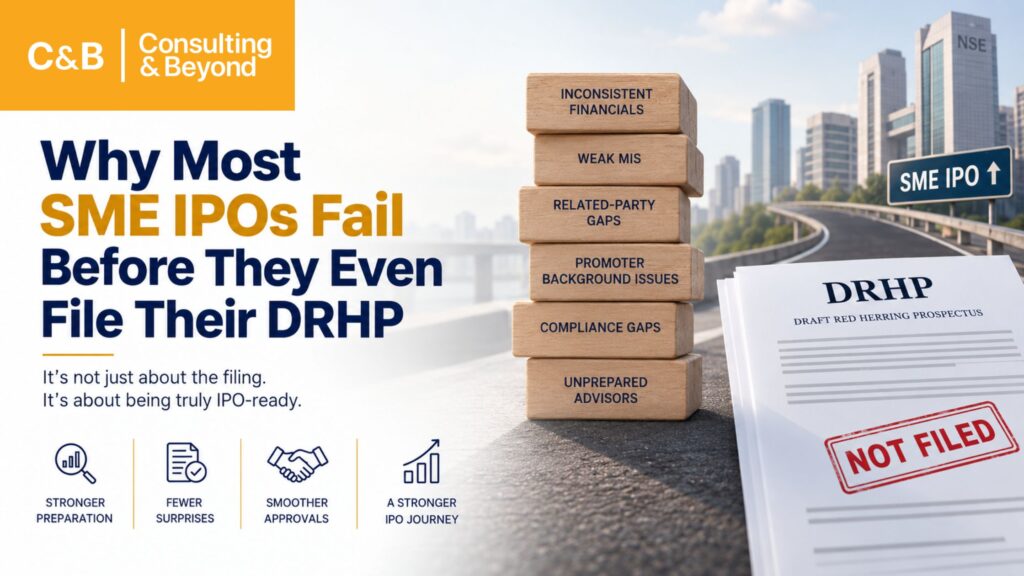
Why Most SME IPOs Fail Before They Even File Their DRHP
Most SME IPO Fails because they begin the IPO journey without adequately preparing their financials, governance, compliance, documentation,…
Rathandeep U
Read
 Blog
Blog
Vendor Dependency Risks In Indian Manufacturing: How Over-Reliance Becomes A Silent Threat
Introduction In my work with manufacturing SMEs across India, I’ve noticed a pattern that rarely shows up in…
 Umesh Golecha
Read
Umesh Golecha
Read