
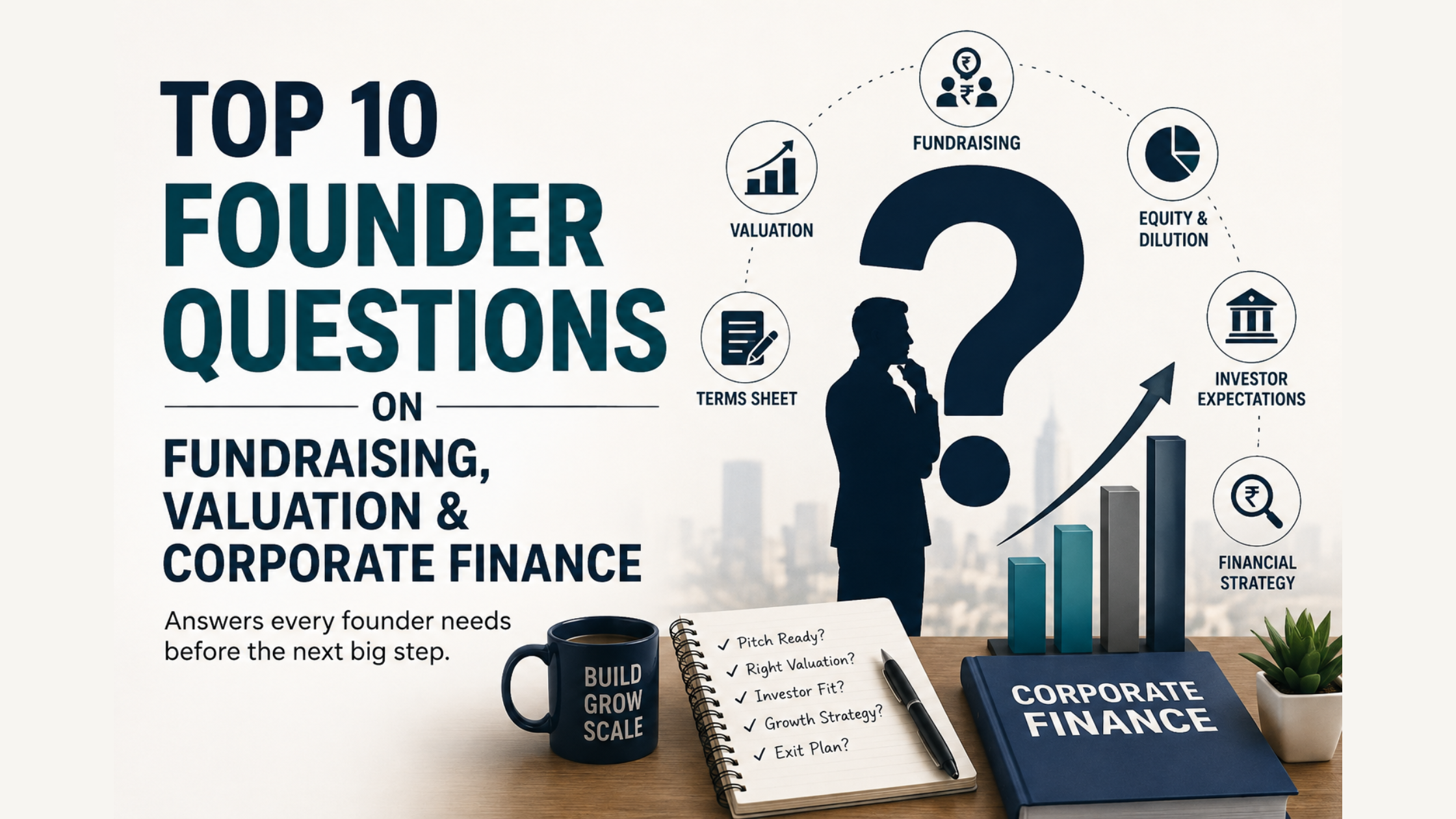
- 1. How do I know how much to raise and at what valuation?
- 2. Should I raise equity or debt? How do I decide?
- 3. My business is profitable on paper, so why is cash always tight?
- 4. How do I prepare my business for investor due diligence?
- 5. What is a Virtual CFO and when does my business actually need one?
- 6. How do I build a pitch deck that gets investor meetings?
- 7. What is budget vs actual variance analysis and why is it important?
- 8. How do I get a bank loan or working capital without collateral?
- 9. What is a feasibility study and do I need one before expansion?
- 10. Is my business ready for an SME IPO?
- Conclusion
- Ready to Raise Capital with Confidence?
Fundraising, Valuation & Corporate Finance are critical pillars of every successful business growth journey. Whether you’re a startup founder, SME owner, or scaling enterprise, understanding how to raise capital, determine the right business valuation, and make sound corporate finance decisions can significantly impact long-term success. This guide answers the most common questions founders have about investor readiness, equity dilution, financial planning, due diligence, and fundraising strategies. Gain practical insights to strengthen your financial foundation, attract the right investors, maximize business value, and make informed decisions that support sustainable growth and create long-term value for your business and stakeholders.
This document answers ten of the most common questions founders ask before raising capital, preparing for an SME IPO, or scaling their business.
1. How do I know how much to raise and at what valuation?
Founders should raise only enough capital to provide 18–24 months of runway with a contingency buffer. The valuation should be supported by recognised valuation methods such as Discounted Cash Flow (DCF), Comparable Companies and transaction multiples, not by aspiration alone. Investors evaluate governance, unit economics, scalability and cash flow quality before agreeing on valuation.
2. Should I raise equity or debt? How do I decide?
Choose equity when capital is needed for long-term growth and preserving cash is important. Choose debt when cash flows are predictable and repayments are affordable. The optimal capital structure balances growth, ownership dilution and financing cost.
3. My business is profitable on paper, so why is cash always tight?
Profit does not equal cash. Working capital locked in receivables, excess inventory, slow collections and capital expenditure often create cash shortages despite accounting profits. Cash flow forecasting and working capital optimisation are essential.
4. How do I prepare my business for investor due diligence?
Investors review financial statements, statutory compliance, taxation, contracts, customer concentration, litigation, governance, intellectual property, management capability and future projections. Preparing these well before fundraising increases credibility.
5. What is a Virtual CFO and when does my business actually need one?
A Virtual CFO provides strategic financial leadership without the cost of a full-time CFO. Businesses usually need one when revenue grows, funding discussions begin, MIS reporting becomes critical or expansion decisions require detailed financial planning.

6. How do I build a pitch deck that gets investor meetings?
An effective pitch deck clearly explains the business problem, solution, market opportunity, traction, business model, competition, financial projections, use of funds and valuation rationale. Investors expect realistic assumptions supported by numbers.
7. What is budget vs actual variance analysis and why is it important?
Budget vs Actual analysis compares planned performance with actual results each month. It helps management identify cost overruns, revenue gaps and operational inefficiencies early so corrective actions can be taken before profitability is affected.
8. How do I get a bank loan or working capital without collateral?
Businesses can explore CGTMSE-backed loans, fintech lenders, supply-chain financing, invoice discounting and government schemes. Strong financial reporting, healthy cash flows and proper documentation significantly improve approval chances.
9. What is a feasibility study and do I need one before expansion?
A feasibility study evaluates market demand, technical viability, financial returns, operational capability and business risks before investing. It helps avoid costly expansion mistakes and supports informed decision-making.
10. Is my business ready for an SME IPO?
IPO readiness goes beyond eligibility. Businesses need consistent profitability, strong governance, reliable financial reporting, compliance, scalable operations, independent leadership and a compelling investor story. Early preparation improves listing success.
Conclusion
Successful fundraising and sustainable business growth depend on financial discipline, robust governance, credible valuation and strategic planning. Working with experienced corporate finance advisors and registered valuers helps founders make informed decisions, improve investor confidence and create long-term enterprise value.
Ready to Raise Capital with Confidence?
Every successful fundraising journey begins long before you meet your first investor. It starts with the right financial strategy, a credible valuation, and a business that is truly investment-ready.
At C&B, our experienced Corporate Finance Consultants help founders and SMEs with:
- ✔ Fundraising strategy and investor readiness
- ✔ Business valuation by Registered Valuers
- ✔ Financial modelling and pitch deck support
- ✔ Due diligence and compliance preparation
- ✔ Debt and equity funding advisory
- ✔ SME IPO readiness and capital structuring
Whether you’re raising your first round or preparing for your next phase of growth, we’ll help you make informed financial decisions with confidence.
📞 Schedule a consultation with our Corporate Finance Consultants today and build a stronger foundation for successful fundraising and long-term business growth.

 Funding your business
How To Write A Business Plan For A Bank Loan
How To Write A Business Plan For A Bank Loan is an essential guide for entrepreneurs seeking business…
Rathandeep U
Read
 Blog
Blog
Feasibility Study In Business: A Complete Guide For Indian SMEs & Family Businesses
A feasibility study is essential for making informed business decisions, especially for Indian SMEs and family-owned businesses. A…
Rathandeep U
Read
 Blog
Blog
How To Write A Funding Pitch: A Complete Guide For Indian SMEs & Family Businesses
How to Write a Funding Pitch is an essential skill for Indian SMEs and family businesses seeking investors,…
Rathandeep U
Read