
SOP Implementation For Warehouse Operations: Why Indian Businesses Fail At It, And How To Get It Right
- What Is An SOP?
- Why Warehouse SOPs Fail In Indian Businesses
- 1. SOPs Are Written but Never Implemented
- 2. Warehouse Teams Are Never Trained Properly
- 3. SOPs Are Too Complex
- 4. No One Measures Compliance
- 5. Leadership Doesn't Follow the Process
- The Warehouse Processes Every Business Should Standardize
- Technology Is Not A Substitute For Process
- The Business Benefits Of Strong Warehouse SOPs
- How To Get SOP Implementation Right
- The Consultant's Perspective
- Final Thoughts
- Ready To Build A High-Performance Warehouse?
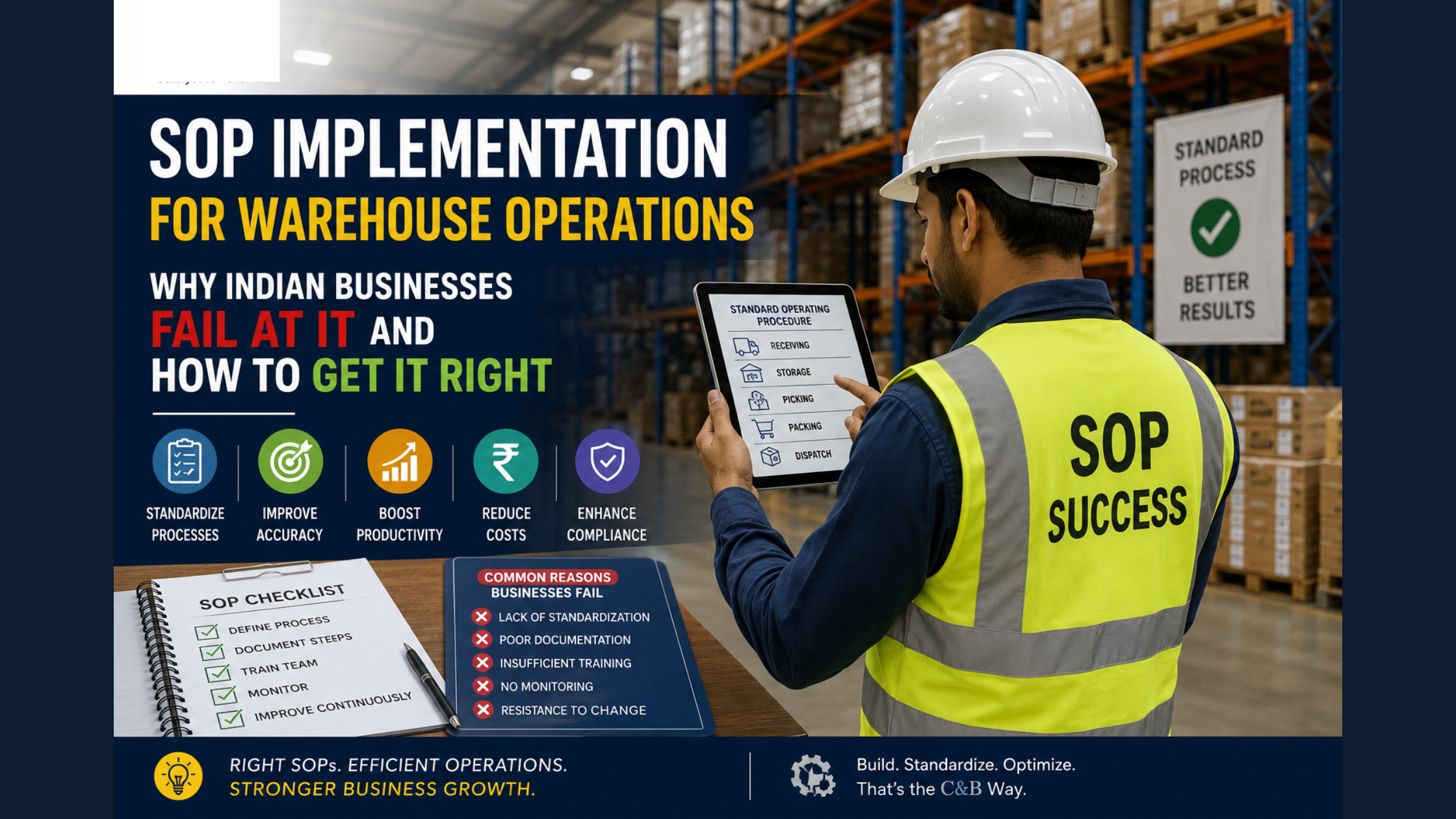
SOP Implementation For Warehouse Operations is essential for improving efficiency, consistency, and productivity across modern warehouses. This guide explains why many Indian businesses struggle with implementing standard operating procedures and highlights the common challenges, including poor documentation, inadequate training, and inconsistent process execution. It also shares practical strategies to develop effective SOPs, streamline inventory management, enhance order accuracy, improve compliance, and reduce operational costs. Whether you manage a retail, FMCG, manufacturing, or logistics business, implementing well-defined warehouse SOPs helps build scalable operations, minimize errors, strengthen supply chain performance, and achieve sustainable long-term business growth.
Every growing business eventually reaches a point where the warehouse becomes either its biggest strength or its biggest bottleneck.
I’ve worked with retail, FMCG, manufacturing, and distribution businesses for over 15 years, and one pattern is remarkably consistent.
Most companies don’t have a warehouse problem.
They have an SOP implementation problem.
- Products arrive late.
- Inventory doesn’t match system records.
- Dispatches are delayed.
- Returns increase.
- Customers complain.
The immediate reaction is usually to hire more people or buy warehouse software.
But technology alone doesn’t solve inconsistent execution.
Processes do.
What Is An SOP?
A Standard Operating Procedure (SOP) is a documented step-by-step process that ensures every warehouse activity is performed consistently, regardless of who is doing the work.
Good SOPs reduce dependency on individuals and create repeatable, measurable operations.
Unfortunately, many businesses either don’t have SOPs, or they have documents that nobody follows.
Why Warehouse SOPs Fail In Indian Businesses
1. SOPs Are Written but Never Implemented
Many companies prepare impressive manuals during audits or certifications.
Once approved, they are filed away and forgotten.
Employees continue working exactly as before.
An SOP only creates value when it becomes part of daily operations.
2. Warehouse Teams Are Never Trained Properly
Simply sharing a PDF or displaying instructions on a notice board is not training.
Warehouse staff need practical demonstrations, supervised implementation, and regular refreshers.
If employees don’t understand why a process exists, they are unlikely to follow it consistently.
3. SOPs Are Too Complex
Many SOP documents are written for management, not for warehouse operators.
Lengthy paragraphs and technical language rarely work on the warehouse floor.
Effective SOPs are:
- Visual
- Simple
- Step-by-step
- Easy to follow
The easier the process, the higher the compliance.
4. No One Measures Compliance
Many businesses measure dispatch volume but never measure whether SOPs are actually being followed.
Without accountability:
- Shortcuts become normal.
- Errors increase.
- Processes slowly break down.
Operational discipline requires regular audits and performance reviews.
5. Leadership Doesn’t Follow the Process
This is perhaps the biggest reason SOP implementation fails.
When supervisors bypass processes to “save time,” employees quickly learn that SOPs are optional.
Culture always follows leadership.
The Warehouse Processes Every Business Should Standardize
Every warehouse should have documented SOPs for:
- Goods receiving
- Quality inspection
- Barcode or SKU tagging
- Storage and put-away
- Inventory counting
- Order picking
- Packing
- Dispatch
- Returns handling
- Damaged goods management
When each activity follows a standard process, operational errors are reduced significantly.
Technology Is Not A Substitute For Process
Many businesses invest in Warehouse Management Systems (WMS), barcode scanners, or ERP software expecting immediate improvements.
Technology improves visibility.
It does not automatically improve discipline.
A warehouse with poor processes will continue producing poor results—even with excellent software.
The most successful organizations implement technology after standardizing their operating procedures.
The Business Benefits Of Strong Warehouse SOPs
Well-implemented SOPs deliver measurable outcomes:
✔ Faster order processing
✔ Better inventory accuracy
✔ Reduced picking and packing errors
✔ Lower operational costs
✔ Higher employee productivity
✔ Improved customer satisfaction
✔ Easier onboarding of new staff
✔ Greater operational scalability
For retail and FMCG businesses operating on thin margins, these improvements directly enhance profitability.

How To Get SOP Implementation Right
Successful implementation follows five practical steps:
Document: Map every critical warehouse process.
Simplify: Use clear language, visuals, and checklists.
Train: Conduct hands-on training for every warehouse employee.
Measure: Track KPIs such as picking accuracy, inventory accuracy, dispatch timelines, and SOP compliance.
Improve: Review processes regularly and update SOPs as operations evolve.
Remember:
An SOP is not a one-time project.
It is a continuous improvement system.
The Consultant’s Perspective
Many SME IPO Consultants assume warehouse efficiency depends on larger facilities or bigger teams.
In reality, sustainable improvement comes from disciplined execution.
The best-performing warehouses are rarely the most expensive.
They are simply the most consistent.
Businesses that build standardized processes today are far better prepared for expansion tomorrow.
Frequently Asked Questions (FAQs)
1. What is SOP implementation in warehouse operations?
SOP implementation involves creating and following standardized procedures for receiving, storage, picking, packing, inventory management, and dispatch to ensure consistent warehouse performance.
2. Why do Indian businesses struggle with warehouse SOP implementation?
Common reasons include poor documentation, inadequate employee training, inconsistent execution, lack of accountability, and resistance to change.
3. What are the benefits of warehouse SOPs?
Warehouse SOPs improve operational efficiency, inventory accuracy, employee productivity, workplace safety, and customer satisfaction while reducing errors and costs.
4. Which warehouse processes should have SOPs?
Every critical process should have an SOP, including receiving, put-away, inventory control, picking, packing, dispatch, returns, and quality checks.
5. How often should warehouse SOPs be updated?
SOPs should be reviewed regularly and updated whenever there are changes in operations, technology, regulations, or business processes.
6. Can SOP implementation reduce warehouse costs?
Yes. Standardized procedures minimize operational errors, reduce waste, improve labor productivity, and optimize inventory management, leading to lower operating costs.
7. Is SOP implementation suitable for SMEs?
Absolutely. Small and medium-sized businesses benefit from improved operational consistency, easier employee training, and scalable warehouse processes.
8. Why choose Consulting & Beyond for SOP implementation?
Consulting & Beyond helps businesses design, implement, and optimize warehouse SOPs tailored to their operations, improving efficiency, compliance, productivity, and long-term business growth.
Final Thoughts
Warehouse operations are no longer just about storing inventory.
They are about delivering speed, accuracy, and customer confidence.
If your warehouse depends on individual experience rather than documented processes, growth will eventually expose the gaps.
Strong SOP implementation transforms warehouses from cost centres into competitive advantages.
In today’s retail and FMCG environment, consistency isn’t just operational excellence—it is a business strategy.
Ready To Build A High-Performance Warehouse?
At C&B, we help SME IPO CONSULTANTS , retail businesses, and FMCG companies design and implement practical warehouse SOPs, improve operational efficiency, and build scalable systems that support long-term growth.
Connect with us today to discover how structured warehouse operations can reduce costs, improve productivity, and prepare your business for sustainable growth.

 Blog
Blog
Feasibility Study In Business: A Complete Guide For Indian SMEs & Family Businesses
A feasibility study is essential for making informed business decisions, especially for Indian SMEs and family-owned businesses. A…
 Rathandeep U
Read
Rathandeep U
Read
 Blog
Blog
How To Write A Funding Pitch: A Complete Guide For Indian SMEs & Family Businesses
How to Write a Funding Pitch is an essential skill for Indian SMEs and family businesses seeking investors,…
Rathandeep U
Read
 Blog
Blog
Why Most SME IPOs Fail Before They Even File Their DRHP
Most SME IPO Fails because they begin the IPO journey without adequately preparing their financials, governance, compliance, documentation,…
Rathandeep U
Read