
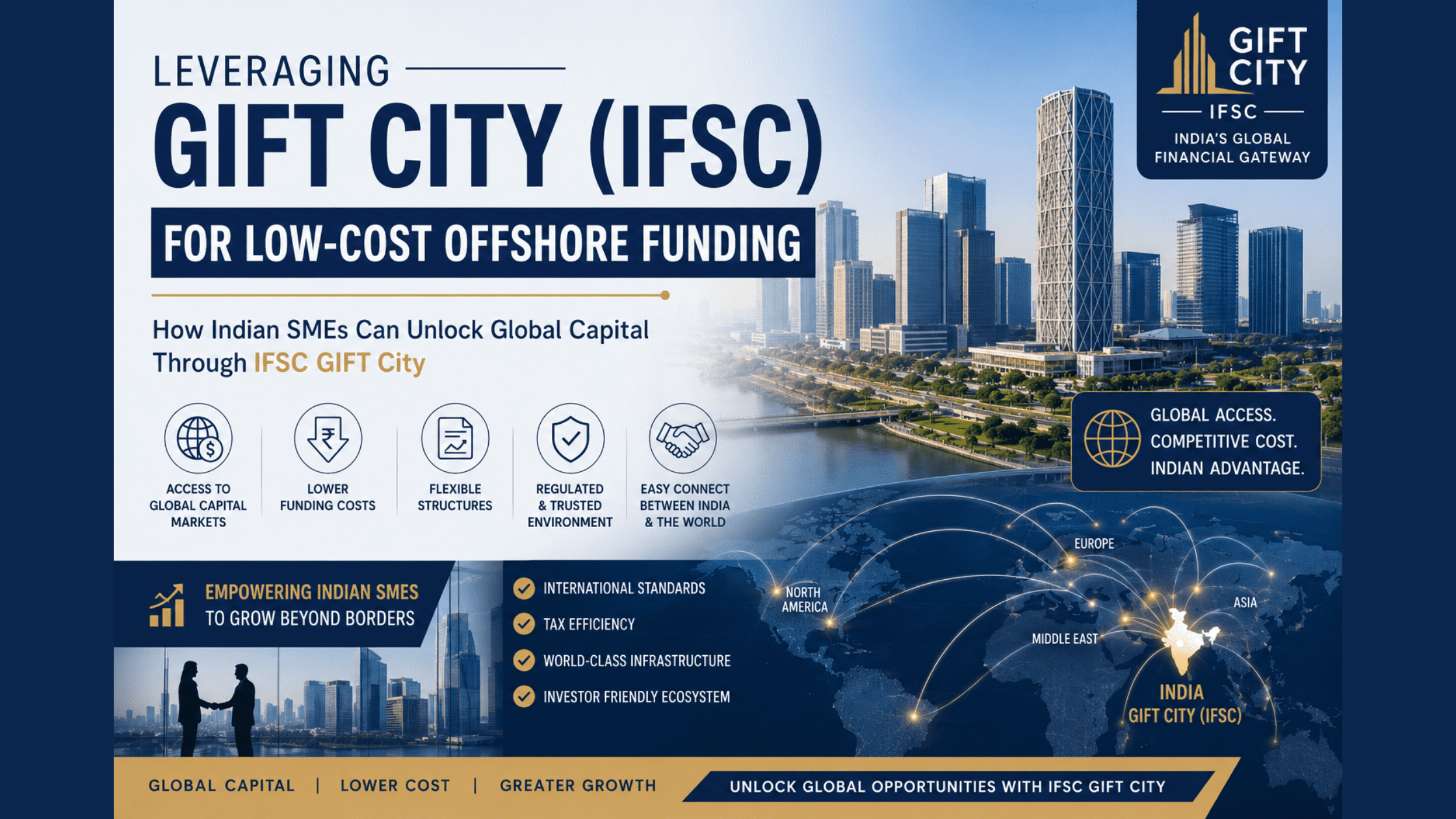
Leveraging GIFT City (IFSC) For Low-Cost Offshore Funding: How Indian SMEs Can Unlock Global Capital Through IFSC GIFT City
- What Is GIFT City IFSC?
- Why Offshore Funding Matters For Indian SMEs
- The Rise Of GIFT City As A Global Financial Hub
- Understanding External Commercial Borrowings (ECB)
- Why GIFT City Makes ECB More Attractive
- Key IFSC GIFT City Benefits For SMEs
- 1. Lower Cost of Borrowing
- 2. Access to Global Liquidity
- 3. Liberal Foreign Exchange Framework
- 4. Tax Efficiency
- 5. Faster Global Transactions
- Which SMEs Can Benefit Most?
- Risks SMEs Must Understand
- 1. Currency Risk
- 2. Regulatory Compliance
- 3. Interest Rate Volatility
- Why Indian Founders Need Strategic Financial Advisors
- GIFT City And The Future Of Indian Corporate Finance
- Frequently Asked Questions:
- 1. What is GIFT City (IFSC)?
- 2. How can SMEs benefit from GIFT City?
- 3. Why is offshore funding cheaper through IFSC?
- 4. What types of funding are available?
- 5. Is GIFT City regulated?
- 6. Can startups and small businesses use IFSC?
- 7. Are there tax advantages in GIFT City?
- 8. How can businesses get started?
- Final Thoughts
Indian SMEs are entering a new phase of business finance consulting services.
For years, accessing international capital markets was largely limited to large corporations with global banking relationships. Small and mid-sized businesses typically depended on:
- Domestic bank loans
- NBFC financing
- Venture capital
- Private debt funds
But the emergence of GIFT City’s International Financial Services Centre (IFSC) is changing the landscape.
Today, Indian founders and SMEs are increasingly exploring Offshore Funding for Indian SMEs through GIFT IFSC structures, foreign currency borrowing, and External Commercial Borrowings (ECBs).
What was once accessible only to large conglomerates is slowly becoming available to growth-oriented MSMEs and mid-sized businesses.
And this could become one of the most important shifts in Indian Corporate Finance Consulting Firms over the next decade.
What Is GIFT City IFSC?
GIFT City (Gujarat International Finance Tec-City) is India’s first operational International Financial Services Centre (IFSC), designed to bring offshore financial activity back to India.
The IFSC framework enables:
- Cross-border financing
- Foreign currency borrowing
- Offshore treasury operations
- Global banking services
- International investment structures
The ecosystem is regulated by the International Financial Services Centres Authority (IFSCA), a unified regulator established to simplify and modernize international finance activities within India.
Why Offshore Funding Matters For Indian SMEs
Traditional domestic borrowing comes with several limitations:
- Higher interest costs
- Limited loan tenures
- Collateral-heavy structures
- Rupee depreciation risks
- Restrictive working capital cycles
As businesses scale globally, these limitations become more visible.
This is where Offshore Funding for Indian SMEs becomes strategically important.
International borrowing can offer:
- Lower interest rates
- Longer repayment periods
- Access to global liquidity
- Foreign currency financing
- Better treasury flexibility
For export-driven companies, technology firms, manufacturing businesses, and globally connected startups, offshore borrowing can significantly improve capital efficiency.
The Rise Of GIFT City As A Global Financial Hub
GIFT IFSC has rapidly evolved into a serious international finance ecosystem.
According to recent reports, banking assets in GIFT IFSC crossed $106 billion, with 37 domestic and global banks operating through IFSC Banking Units (IBUs).
Major global institutions, including:
- HSBC
- JP Morgan
- Citi
- Deutsche Bank
- MUFG
- Standard Chartered
have established a presence within GIFT IFSC.
This institutional growth is creating a strong foundation for:
- Foreign currency lending
- Cross-border trade financing
- Treasury management
- Offshore debt structures
Understanding External Commercial Borrowings (ECB)
One of the biggest opportunities emerging from GIFT IFSC is the growing use of External Commercial Borrowings (ECB).
ECB refers to loans raised by eligible Indian entities from recognized foreign lenders under RBI regulations.
These borrowings can include:
- Bank loans
- Foreign currency loans
- Buyers’ credit
- Supplier credit
- Bonds and notes
The RBI has progressively liberalized ECB regulations to improve access to global capital. (ICSI)
For SMEs, this creates opportunities to:
- Reduce financing costs
- Access larger capital pools
- Diversify funding sources
Why GIFT City Makes ECB More Attractive
Traditionally, offshore borrowing involved complex overseas structures routed through:
- Singapore
- Mauritius
- Dubai
- Hong Kong
GIFT IFSC changes this dynamic.
Businesses can now access global financial services within an Indian regulatory environment while benefiting from internationally competitive frameworks.
This creates several advantages.

Key IFSC GIFT City Benefits For SMEs
1. Lower Cost of Borrowing
Foreign currency loans often carry lower interest rates compared to domestic rupee borrowing.
This can significantly reduce:
- Interest burden
- Financing costs
- Capital expenditure pressure
For businesses with export revenues or foreign currency inflows, this becomes even more beneficial.
2. Access to Global Liquidity
Global lenders operating in GIFT IFSC can provide:
- Structured debt products
- Trade finance
- Treasury solutions
- Syndicated loans
This expands financing options beyond Indian banking limitations.
3. Liberal Foreign Exchange Framework
GIFT IFSC operates under a more flexible cross-border regulatory framework.
Industry experts note that IFSC structures offer greater flexibility for treasury and offshore financing activities compared to traditional FEMA-regulated structures.
This improves:
- Capital movement efficiency
- International transaction flexibility
- Treasury operations
4. Tax Efficiency
GIFT IFSC offers several tax incentives aimed at attracting global financial activity.
Benefits include:
- Tax holidays for eligible businesses
- Competitive tax treatment
- Exemptions for certain offshore activities
These incentives strengthen GIFT City’s attractiveness compared to offshore jurisdictions.
5. Faster Global Transactions
The launch of the Foreign Currency Settlement System (FCSS) has improved foreign currency transaction efficiency within IFSC.
This reduces:
- Settlement delays
- Dependence on overseas correspondent banks
- Transaction costs
For businesses engaged in imports, exports, and cross-border operations, this is a major operational advantage.
Which SMEs Can Benefit Most?
Not every business is immediately suitable for offshore funding.
However, the following sectors are particularly well-positioned:
- Export-oriented manufacturing
- SaaS and technology firms
- Pharmaceutical companies
- Renewable energy businesses
- Engineering exporters
- Global sourcing businesses
- Logistics and shipping companies
Businesses with:
- Stable revenues
- Forex inflows
- Strong governance
- Scalable business models
are likely to benefit the most.
Risks SMEs Must Understand
While offshore funding offers advantages, businesses must also understand the risks.
1. Currency Risk
Foreign currency loans expose businesses to exchange rate fluctuations.
A depreciating rupee can increase repayment obligations.
Proper hedging strategies are critical.
2. Regulatory Compliance
ECB structures require strict compliance with RBI and IFSCA regulations.
Poor structuring can create:
- Compliance risks
- Tax complications
- Reporting challenges
3. Interest Rate Volatility
Global interest rates may fluctuate depending on:
- US Federal Reserve policies
- Global liquidity cycles
- Geopolitical developments

Why Indian Founders Need Strategic Financial Advisors
Offshore borrowing is not just about accessing cheaper debt.
It requires:
- Treasury planning
- Forex management
- Capital structuring
- Risk mitigation
- Regulatory understanding
This is why many businesses work with:
- Treasury consultants
- Investment bankers
- Cross-border legal experts
- Corporate finance advisors
The future of Indian SME finance will increasingly depend on strategic global capital management—not just domestic borrowing relationships.
GIFT City And The Future Of Indian Corporate Finance
Industry experts believe GIFT IFSC could eventually become India’s gateway to global finance.
Recent reports suggest growing interest from global corporations, international banks, and treasury operations looking at GIFT City as an alternative to Singapore and Dubai.
This momentum signals a larger transformation:
- India is slowly onshoring offshore finance
- Global capital is becoming more accessible domestically
- SMEs are gaining access to sophisticated funding structures
The implications are massive.
Final Thoughts
The future of Indian business financing is becoming increasingly global.
As GIFT IFSC matures, Offshore Funding for Indian SMEs will likely become:
- More accessible
- More competitive
- More strategically important
Businesses that understand international capital structures early will gain:
- Lower financing costs
- Better treasury flexibility
- Stronger global competitiveness
For Indian founders, GIFT City is no longer just a policy experiment.
It is emerging as a real financial gateway connecting Indian entrepreneurship with global capital markets.
And for ambitious SMEs, that opportunity may be too important to ignore.
As India’s financial ecosystem evolves, GIFT City (IFSC) is creating new opportunities for SMEs to access global capital, optimize borrowing costs, and diversify funding sources.
However, offshore funding, ECB structuring, foreign currency loans, and regulatory compliance require careful planning and expert guidance.
At C&B, we help SMEs and growth-stage businesses:
✔ Evaluate offshore funding opportunities
✔ Assess ECB eligibility and funding structures
✔ Optimize capital costs and debt strategy
✔ Navigate RBI and IFSC regulations
✔ Build investor and lender-ready financial frameworks
📌 The right funding structure can significantly improve cash flow, reduce financing costs, and accelerate growth.
Connect with our Corporate Finance experts today for a consultation and discover how your business can leverage GIFT City (IFSC) for smarter, lower-cost global funding.

 Blog
Blog
Feasibility Study In Business: A Complete Guide For Indian SMEs & Family Businesses
A feasibility study is essential for making informed business decisions, especially for Indian SMEs and family-owned businesses. A…
Rathandeep U
Read
 Blog
Blog
How To Write A Funding Pitch: A Complete Guide For Indian SMEs & Family Businesses
How to Write a Funding Pitch is an essential skill for Indian SMEs and family businesses seeking investors,…
Rathandeep U
Read
 Blog
Blog
Why Most SME IPOs Fail Before They Even File Their DRHP
Most SME IPO Fails because they begin the IPO journey without adequately preparing their financials, governance, compliance, documentation,…
Rathandeep U
Read