
- Introduction
- What Is Vendor Dependency?
- Why Indian Manufacturing SMEs Are Especially Vulnerable
- 1. Comfort With Familiar Vendors
- 2. Lack of Supplier Mapping
- 3. No Alternate Qualification Process
- 4. Price Dependency
- How Vendor Dependency Becomes Dangerous
- The Typical Trigger Events:
- The Real Costs (Beyond Purchase Price)
- 1. Production Loss
- 2. Customer Credibility Damage
- 3. Emergency Procurement Premiums
- 4. Internal Chaos
- 5. Negotiation Weakness
- The Most Overlooked Risk: Generational Supplier Dependence
- Early Warning Signs You Should Not Ignore
- How Over-Reliance Slows Business Growth
- Practical Solutions: How SMEs Can Reduce Vendor Dependency Risks
- 1. Supplier Diversification
- 2. Vendor Qualification System
- 3. Vendor Risk Mapping
- 4. Contractual Clarity
- 5. Inventory Strategy
- 6. Second-Line Procurement Leadership
- The Leadership Insight
- FAQs: Vendor Dependency Risks In Manufacturing
- 1. What is vendor dependency in manufacturing?
- 2. Why is vendor dependency risky for Indian manufacturers?
- 3. What are the signs of high vendor dependency?
- 4. How can businesses reduce vendor dependency risks?
- 5. What is the impact of vendor dependency on business growth?
- Final Thought
Introduction
In my work with manufacturing SMEs across India, I’ve noticed a pattern that rarely shows up in financial statements but often explains sudden crises:
A factory that ran smoothly for years…
Suddenly stops.
No strike.
No recession.
No machinery breakdown.
The reason?
One supplier failed.
Many family-managed manufacturing businesses operate efficiently, maintain loyal customers, and control costs well. Yet they unknowingly carry a single point of failure: vendor dependency.
And unlike market competition, this threat is silent until the day it becomes catastrophic.
What Is Vendor Dependency?
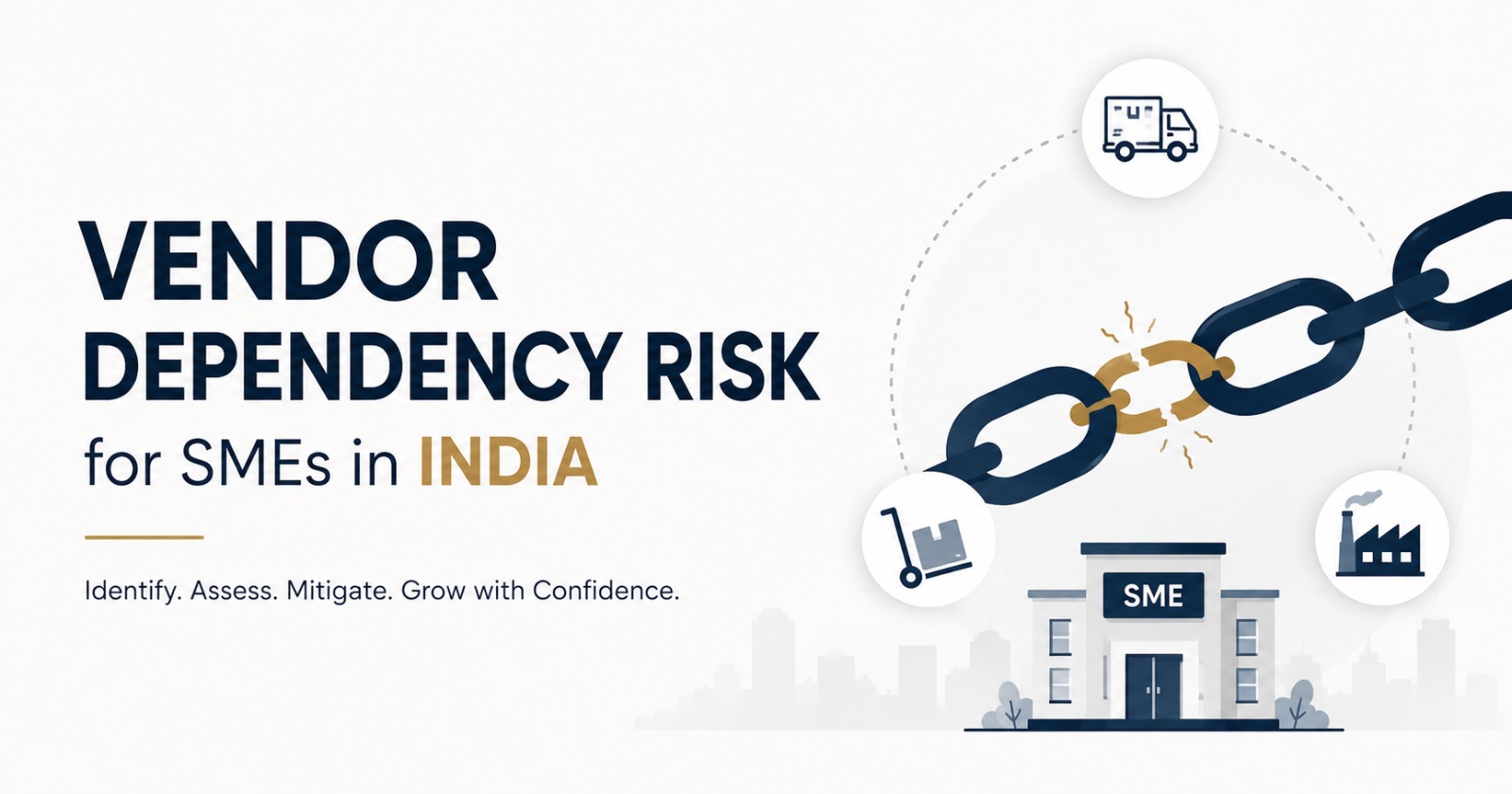
Vendor dependency occurs when a business relies heavily on one supplier, one raw material source, or one critical service provider for core operations.
It usually develops slowly and innocently:
- A supplier supported you during early struggles
- Pricing was competitive
- Quality was consistent
- Trust grew over the years
So the business stops exploring alternatives.
What began as loyalty gradually becomes risk concentration.
Why Indian Manufacturing SMEs Are Especially Vulnerable
Family-managed businesses in India are relationship-driven, and that is a strength.
But in supply chains, relationships sometimes replace risk management.
Here are common realities I see:
1. Comfort With Familiar Vendors
Promoters often prefer known vendors over new ones because:
- “We understand each other”
- “They supported us when no one else did”
- “Changing supplier is risky”
Ironically, not changing becomes the bigger risk.
2. Lack of Supplier Mapping
Most SMEs track customers carefully.
Very few track supplier concentration.
Ask a simple question:
If your primary vendor stops tomorrow, how many days can your plant operate?
Many owners do not know the answer.
3. No Alternate Qualification Process
Alternate vendors are not onboarded because:
- Testing takes time
- Engineering validation is pending
- Documentation is incomplete
So the business postpones vendor development… indefinitely.
4. Price Dependency
Sometimes one supplier offers slightly lower pricing.
Gradually, procurement shifts entirely to them.
Short-term savings.
Long-term vulnerability.
How Vendor Dependency Becomes Dangerous
The risk doesn’t show daily.
It shows suddenly, and expensively.
The Typical Trigger Events:
- Vendor financial distress
- Labour issues at supplier plant
- Regulatory shutdown
- Export/import restrictions
- Logistics disruption
- Quality rejection
- Ownership dispute in supplier’s family business
Your production stops, even though your factory is fully ready.
This is why I call it a silent threat.
The Real Costs (Beyond Purchase Price)
Most businesses think vendor risk means higher procurement costs.
No.
The real costs are operational and strategic.
1. Production Loss
A 5-day raw material shortage can disrupt a 3-month production schedule.
2. Customer Credibility Damage
Customers don’t accept “supplier problem” as a reason.
To them, it is your failure.
3. Emergency Procurement Premiums
When panic buying begins:
- You pay higher rates
- Accept lower credit
- Compromise on quality
4. Internal Chaos
- Planning collapses
- Dispatch delays increase
- Teams firefight instead of operating
5. Negotiation Weakness
When a supplier knows you cannot operate without them,
you lose bargaining power, permanently.
The Most Overlooked Risk: Generational Supplier Dependence
In family businesses, vendors are often tied to the founder’s personal relationships.
The next generation inherits the business…
and also inherits unverified supplier dependence.
This becomes dangerous when:
- The founder retires
- Supplier ownership changes
- Personal trust no longer applies
The business suddenly realises:
The system was relationship-driven, not structure-driven.
Early Warning Signs You Should Not Ignore
If you observe these, vendor risk already exists:
- One vendor supplies >50% of a critical input
- No written quality standards
- Pricing decided informally
- No periodic vendor performance review
- Procurement handled personally by promoter
- No approved alternate supplier
Most businesses ignore these because operations still run smoothly.
That smoothness is temporary stability, not resilience.
How Over-Reliance Slows Business Growth
Vendor dependency doesn’t only cause crises.
It quietly restricts scale.
Here’s how:
- You cannot increase production quickly
- Expansion depends on supplier capacity
- You hesitate to enter new markets
- You avoid large orders due to supply uncertainty
In short:
Your growth becomes limited by someone else’s readiness.
Practical Solutions: How SMEs Can Reduce Vendor Dependency Risks
This is not about replacing loyal vendors.
It is about protecting the business.
1. Supplier Diversification
For critical materials, maintain at least two qualified suppliers.
Even if one handles 70%, the second must be technically ready.
2. Vendor Qualification System
Create a structured onboarding process:
- Technical approval
- Sample validation
- Documentation
- Trial order
Do this before you need them.
3. Vendor Risk Mapping
Categorize suppliers:
- Critical
- Important
- Replaceable
Critical vendors require backup planning.
4. Contractual Clarity
Formalize:
- Lead times
- Quality parameters
- Delivery commitments
Informal trust should be supported by formal structure.
5. Inventory Strategy
For critical inputs, maintain safety stock based on:
- Lead time
- Supply reliability
- Demand variability
Inventory is not always inefficiency.
Sometimes it is insurance.
6. Second-Line Procurement Leadership
Procurement should not depend solely on the promoter.
Train a capable procurement manager who understands both cost and risk.
The Leadership Insight
Many manufacturing businesses focus on:
- Sales growth
- Machinery expansion
- Market development
But sustainable growth depends equally on supply stability.
Customers rarely leave because you priced higher.
They leave because you couldn’t deliver consistently.
And consistent delivery begins with a resilient supply chain.
FAQs: Vendor Dependency Risks In Manufacturing
1. What is vendor dependency in manufacturing?
Vendor dependency occurs when a business relies heavily on a single or limited number of suppliers for critical raw materials or services.
2. Why is vendor dependency risky for Indian manufacturers?
Over-reliance can lead to supply disruptions, price volatility, and reduced bargaining power, impacting production and profitability.
3. What are the signs of high vendor dependency?
Key signs include reliance on one supplier, lack of alternatives, frequent delays, and inability to negotiate pricing or terms effectively.
4. How can businesses reduce vendor dependency risks?
Companies can diversify suppliers, build strategic partnerships, maintain buffer inventory, and develop backup sourcing strategies.
5. What is the impact of vendor dependency on business growth?
It can slow down scaling, increase operational risks, and make the business vulnerable to external shocks and supplier failures.
Final Thought
Vendor relationships are valuable.
Vendor dependence is dangerous.
A strong business is not the one that runs well in normal times.
It is the one that continues running when something goes wrong.
Market competition is visible.
Vendor dependency is invisible until the day it stops your factory.
As leaders of family-managed manufacturing businesses, the goal is not only growth.
It is continuity.
Because in manufacturing, the biggest risk is not losing customers.
It is losing the ability to serve them.
“For an SME, vendor dependency is not just a procurement risk; it is a business continuity risk. The goal is not to eliminate dependence on vendors, but to ensure that no single vendor has the power to disrupt your growth.”
— Mr. Umesh Golecha, Management Consultant for Indian SMEs

 Blog
Blog
Feasibility Study In Business: A Complete Guide For Indian SMEs & Family Businesses
A feasibility study is essential for making informed business decisions, especially for Indian SMEs and family-owned businesses. A…
 Rathandeep U
Read
Rathandeep U
Read
 Blog
Blog
How To Write A Funding Pitch: A Complete Guide For Indian SMEs & Family Businesses
How to Write a Funding Pitch is an essential skill for Indian SMEs and family businesses seeking investors,…
Rathandeep U
Read
 Blog
Blog
Why Most SME IPOs Fail Before They Even File Their DRHP
Most SME IPO Fails because they begin the IPO journey without adequately preparing their financials, governance, compliance, documentation,…
Rathandeep U
Read