
- The Fundamental Difference In Scope
- When To Choose A Management Consulting Firm
- Choose Management Consulting If:
- When to Choose A Virtual CFO (vCFO) Service
- Choose a Virtual CFO If:
- FAQs: Management Consultant For Your Business
- 1. What does a management consultant do?
- 2. When should a business hire a management consultant?
- 3. How can management consultants help SMEs?
- 4. How do you choose the right management consultant?
- Making The Right Choice: A Blended Approach
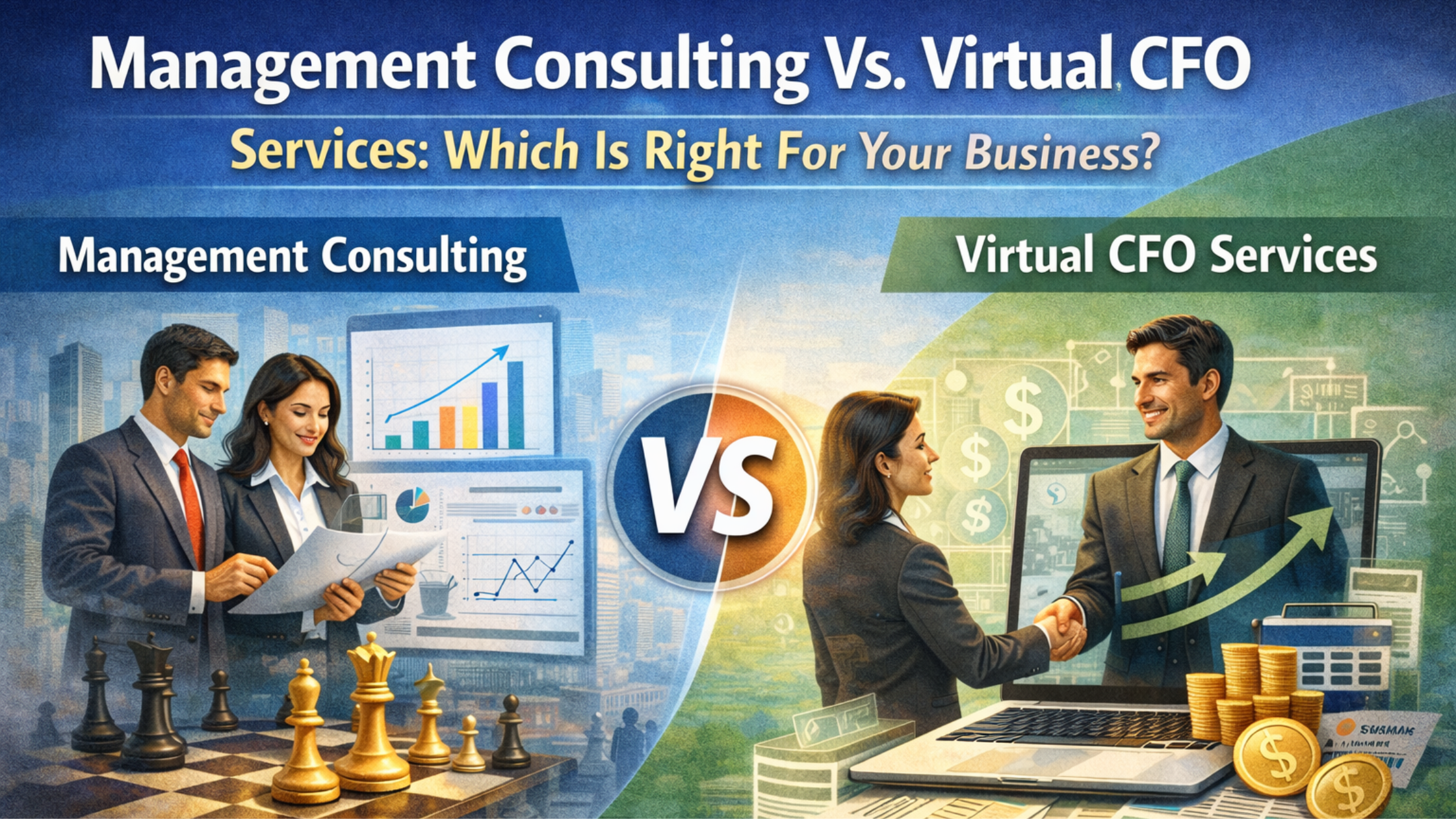
Management Consulting vs Virtual CFO Services highlights the key differences between strategic advisory and financial leadership roles for businesses. Management consulting focuses on overall business growth, operations, and strategy, helping organizations solve complex challenges. In contrast, Virtual CFO services provide specialized financial expertise like budgeting, cash flow management, and compliance on a flexible, cost-effective basis.
While consultants guide high-level decision-making, Virtual CFOs drive financial discipline and execution. Businesses often need both depending on their stage—consulting for transformation and Virtual CFO services for financial clarity, scalability, and informed decision-making in a growing business environment.
For growing businesses, particularly MSMEs (Micro, Small, and Medium Enterprises) and Family-Managed Businesses (FMBs) in India, the need for high-level expertise often outpaces internal capacity. The choice then becomes:How do you decide to engage a Management Consulting Firm for specific projects or hire a Virtual CFO (vCFO) for ongoing Expansion needs of the business?
While both services introduce external expertise, their scope, commitment level, and cost structure are fundamentally different. Choosing the right service depends entirely on your business’s current pain point.
The Fundamental Difference In Scope
| Feature | Management Consulting Firm | Virtual CFO (vCFO) Service |
| Goal | Project-based change: Solve a specific, defined problem (e.g., Inventory optimization, ERP implementation, IPO readiness). | Continuous leadership: Provide ongoing financial strategy, oversight, and governance. |
| Duration | Finite, fixed term: Typically 3 to 12 months, ending upon project completion. | Long-term, retainer-based: Ongoing relationship, often spanning years. |
| Focus | Implementation & Process: How the business operates (SOPs, technology, governance structure). | Strategy & Finance: Managing capital, P&L, risk, and long-term financial health. |
| Deliverable | Measurable outcome: A fully implemented ERP, a successful succession plan, or documented cost savings. | Function: Monthly budgeting, quarterly Board reports, forecasting, and team mentorship. |
| Personnel | Team of consultants (Analysts, Managers, Partners). | Typically, one senior financial expert who acts as the “Fractional CFO.” |
When To Choose A Management Consulting Firm
Management Consulting is ideal when you have a defined structural or operational problem that requires a specialized, intensive solution with a fixed end date.
Choose Management Consulting If:
- You Need Implementation Expertise: You know you need to implement a new ERP system, but your internal team lacks the technical know-how to select, customize, and migrate data correctly.
- You Need to Fix a Broken Process: Your margins are eroding due to an inefficient supply chain, disorganized inventory management, or chaotic production workflows. You need someone to step in, diagnose the process, and implement the fix (as seen with firms focusing on operational excellence).
- You Are Preparing for a Major Event: You are gearing up for an SME IPO, a major acquisition, or a complex corporate restructuring. This requires a dedicated team to manage due diligence and compliance preparation.
- You Require Deep, Niche Skill Sets: You need expertise in areas like Green Manufacturing alignment, complex transfer pricing, or specialized GST litigation that your finance team doesn’t encounter daily.
The Focus: Management consultants bring the methodology and muscle to execute a major project.

When to Choose A Virtual CFO (vCFO) Service
A vCFO service is the better choice when your core challenge is a lack of senior, strategic financial leadership to guide the business day-to-day and week-to-week.
Choose a Virtual CFO If:
- You Lack Senior Financial Strategy: Your business has grown past the capabilities of a bookkeeper or a junior accountant, but you cannot afford a full-time, ₹50-lakh-per-annum CFO.
- You Need Better Cash Flow Management: You need reliable forecasting, budgeting, and performance reporting to move from reacting to historical data to proactively managing future cash flow.
- You Need to Professionalize Governance: The vCFO establishes monthly reporting cycles, conducts variance analysis, and installs the discipline needed to present a professional face to investors or banks.
- You Need Financial Team Mentorship: The vCFO acts as a mentor to your existing finance staff, training them on best practices, automation, and reporting, thus raising the internal capability over time.
The Focus: The vCFO provides the strategic insight and discipline of an experienced finance leader, on a fractional, retainer basis.
FAQs: Management Consultant For Your Business
1. What does a management consultant do?
A management consultant analyzes business operations and provides strategies to improve efficiency, profitability, and growth.
2. When should a business hire a management consultant?
Businesses should hire a consultant when facing operational challenges, slow growth, scaling issues, or the need for strategic planning.
3. How can management consultants help SMEs?
They help SMEs streamline processes, reduce costs, improve productivity, and implement structured business systems.
4. How do you choose the right management consultant?
Choose a consultant with relevant industry experience, a strong track record, and a practical implementation approach aligned with your business goals.
Making The Right Choice: A Blended Approach
It is important to remember that these services are not mutually exclusive. Many successful MSMEs adopt a blended approach:
- Foundation First: Hire a vCFO to establish strong financial controls, accurate monthly reporting, and budgeting (getting the day-to-day right).
- Project Scaling: Engage a Management Consulting Firm when a specific, massive project—such as a full Digital Transformation (Excel to ERP) or a Family Succession Plan—needs to be implemented rapidly and correctly.
Ultimately, both services are designed to help you Think Growth. The management consultant executes the change in process and structure; the vCFO ensures the financial strategy and governance are in place to sustain that growth.

 Blog
Blog
Healthcare Industry in India: Investment & Growth Opportunities
India’s healthcare sector is entering a new phase of formalisation, consolidation and capital-driven growth. The market is estimated…
 Rathandeep U
Read
Rathandeep U
Read
 Blog
Blog
Feasibility Study In Business: A Complete Guide For Indian SMEs & Family Businesses
A feasibility study is essential for making informed business decisions, especially for Indian SMEs and family-owned businesses. A…
Rathandeep U
Read
 Blog
Blog
How To Write A Funding Pitch: A Complete Guide For Indian SMEs & Family Businesses
How to Write a Funding Pitch is an essential skill for Indian SMEs and family businesses seeking investors,…
Rathandeep U
Read