
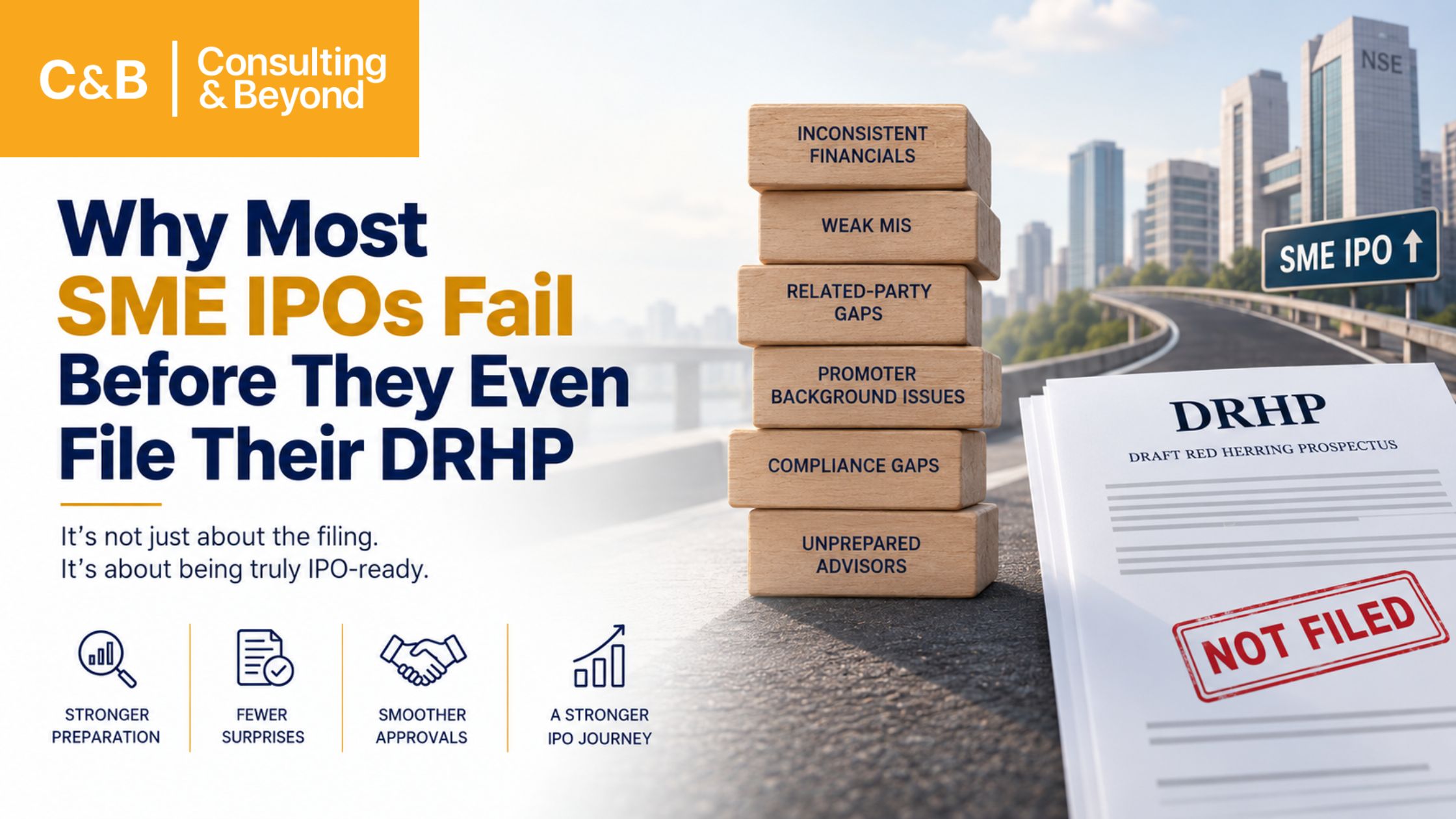
- Introduction: Why Most SME IPOs Fail Even Before They Even File Their DRHP
- 1. The Financial & Accounting Trap: Books Built For Tax Savings, Not Public Valuation
- Key Accounting Roadblocks:
- 2. Governance And Board Dynamics: Transitioning From Family Rule To Public Stewardship
- Common Governance Deficiencies:
- 3. Vague Objects Of The Issue And Weak Growth Capital Strategy
- Where SME Promoters Go Wrong:
- 4. Choosing The Wrong Advisory Ecosystem
- 5. Strategic Breakdown: Pre-DRHP Failure Vs. Listing-Ready Approach
- 6. The Pre-IPO Roadmap: How Indian SMEs Can Ensure DRHP Success
- Frequently Asked Questions
- 1. Why do SME IPOs fail before filing their DRHP?
- 2. What is SME IPO readiness?
- 3. Why is DRHP preparation important?
- 4. When should an SME start IPO preparation?
- 5. Can an IPO consultant help with SME IPO preparation?
- 6. Is meeting IPO eligibility criteria enough?
- 7. What is the first step toward SME IPO readiness?
- Conclusion: An IPO Is A Transformation, Not An Event
Most SME IPO Fails because they begin the IPO journey without adequately preparing their financials, governance, compliance, documentation, and business operations. Filing a DRHP is only one part of the process; genuine IPO readiness requires addressing potential weaknesses well in advance. SMEs must strengthen internal controls, maintain accurate financial records, resolve compliance issues, improve corporate governance, and demonstrate a scalable business model. Early preparation can help identify risks, avoid costly delays, and build investor confidence. This blog explains the key reasons companies struggle before filing their DRHP and highlights how a structured IPO readiness assessment can prepare SMEs for a successful IPO journey.
Introduction: Why Most SME IPOs Fail Even Before They Even File Their DRHP
Over the last few years, the Indian capital markets have witnessed an unprecedented surge in Small and Medium Enterprise (SME) Initial Public Offerings (IPOs). Platforms like NSE Emerge and BSE SME have democratized access to public equity, allowing high-growth Indian enterprises to raise capital, unleash enterprise value, and scale rapidly. From manufacturing hubs in Gujarat and Maharashtra to tech and services centers in Bengaluru and NCR, SME founders are eager to ring the bell at the stock exchange.
However, behind every successful listing story lies a stark, unpublicized reality: more than 70% of SME IPO aspirants fail long before their Draft Red Herring Prospectus (DRHP) ever reaches the stock exchange or market regulators.
As an experienced Business Finance Management Consultant and strategic IPO Consultant in the Indian ecosystem, I regularly interact with promoters who assume that an IPO is merely a legal and documentation exercise. They believe that once a Merchant Banker is appointed, listing is guaranteed. The reality, however, is that an IPO is a structural transformation of how a business operates, governs, reports, and plans its capital structure.
In this comprehensive guide, we dissect the primary reasons why Indian SME IPO aspirants stall in the pre-filing phase and outline what promoters must do to ensure a successful listing journey.
1. The Financial & Accounting Trap: Books Built For Tax Savings, Not Public Valuation
The single biggest hurdle for Indian SMEs transitioning to the public market is their historical approach to financial management. For decades, Indian private companies have optimized their financial statements primarily for tax minimization rather than transparent value creation.
Key Accounting Roadblocks:
- Unreconciled Related-Party Transactions (RPTs): Loans from promoters, rent paid to family members for business premises, or sales to group companies without arm’s-length documentation. Stock exchanges scrutinize RPTs intensely.
- Inconsistent Revenue Recognition and Inventory Valuation: Failure to align accounting standards with Indian Accounting Standards (Ind AS) or standard AS rules, leading to massive audit restatements.
- GST and Tax Discrepancies: Mismatches between GSTR-1, GSTR-3B, and audited balance sheets. Statutory dues delayed or pending litigation can derail due diligence instantly.
- Promoter Compensation vs. Business Profits: Artificially inflated or suppressed promoter remuneration that paints an inaccurate picture of operational profitability.
When an IPO Consultant begins the financial due diligence, these discrepancies require months of historical restatements, delaying the DRHP draft or inflating legal and audit expenses beyond budget.
2. Governance And Board Dynamics: Transitioning From Family Rule To Public Stewardship
An SME listing requires shifting from a “Promoter-driven” mindset to a “Board-governed” enterprise. Many Indian SME founders struggle with this shift in control and oversight.
Common Governance Deficiencies:
- Lack of Qualified Independent Directors: Promoters often appoint friends or distant relatives who lack market credibility, financial expertise, or independence.
- Absence of Functional Board Committees: Mandatory committees, such as the Audit Committee, Nomination & Remuneration Committee (NRC), and Stakeholders Relationship Committee, often exist only on paper.
- Weak Internal Financial Controls (IFC): Absence of documented internal control frameworks, delegated authority matrices, and automated accounting systems.
3. Vague Objects Of The Issue And Weak Growth Capital Strategy
Merchant bankers and stock exchanges will not approve a DRHP if the “Objects of the Issue” lack clarity, commercial rationale, or bank appraisal. Regulators in India strictly prohibit fundraising for generic, unquantified objectives.
Where SME Promoters Go Wrong:
- Inflated Working Capital Estimates: Claiming large capital requirements without a clear bank appraisal or historical utilization justification.
- Unbacked Capital Expenditure Plans: Proposing plant expansion or machinery purchase without quotation proofs, land possession, or clear vendor contracts.
- Debt Repayment Ambiguities: Attempting to pay off unofficial or unstructured loans using public proceeds without clear documentary trails.
Engaging a competent Business Finance Management Consultant early ensures that the capital structuring, working capital appraisal, and financial forecasting are realistic, defensible, and attractive to institutional and HNI investors.
4. Choosing The Wrong Advisory Ecosystem
An SME IPO is an orchestrational effort requiring an ecosystem of experts: Merchant Bankers, Peer-Reviewed Statutory Auditors, Legal Counsels, Valuers, and Registrars. Promoters often make critical errors during advisory selection:
- Selecting Merchant Bankers Solely on Fees: Choosing advisers based on low upfront costs rather than track record, underwriting capability, or institutional reach.
- Non-Peer Reviewed Auditors: Stock exchange guidelines mandate that the financial statements in the DRHP must be audited or restated by a Chartered Accountant firm with a valid Peer Review Certificate issued by the ICAI.
- Absence of an Independent Pre-IPO Advisor: Expecting the Merchant Banker to do the foundational cleanup. A Merchant Banker’s role begins when the business is ready; preparing the company for readiness requires a dedicated IPO Consultant.
5. Strategic Breakdown: Pre-DRHP Failure Vs. Listing-Ready Approach
| Key Metric / Area | The Failed Pre-DRHP Approach | The Listing-Ready Approach |
|---|---|---|
| Financial Reporting | Tax-minimization mindset, unaligned RPTs, GST mismatches. | Restated 3-year financials, clean RPT audit, seamless tax clearance. |
| Board Composition | Family/friends as directors; token compliance. | Diverse board with seasoned Independent Directors and active committees. |
| Use of IPO Proceeds | Vague growth claims, unappraised working capital. | Bank-appraised objects, verified vendor quotes, clear ROI roadmap. |
| Advisor Integration | Last-minute Merchant Banker appointment with messy books. | Early onboarding of a Business Finance Management Consultant for pre-IPO grooming. |
| Key Metric/Area | The Failed Pre-DRHP Approach | The Listing – Ready Approach |
| Management Consultant for pre-IPO grooming. | ||
| Internal Systems | Manual spreadsheets, informal delegation. | ERP implementation, documented Internal Financial Controls (IFC). |
6. The Pre-IPO Roadmap: How Indian SMEs Can Ensure DRHP Success
To avoid costly delays, regulatory rejections, or abandoned filings, SME promoters should adopt a structured 12-to-18-month Pre-IPO readiness framework:
- Conduct a Pre-IPO Diagnostic Audit (Month 1 – 3): Partner with an experienced IPO Consultant to perform a comprehensive financial, legal, and operational diagnostic. Identify all gaps in tax compliance, corporate structure, and accounting.
- Financial Restatement and Restructuring (Month 4 – 6): Restate historical financials for the past 3 fiscal years in compliance with stock exchange requirements. Phase out informal related-party transactions and establish arm’s-length pricing.
- Governance Transformation (Month 6 – 9): Reconstitute the Board of Directors. Onboard independent professionals with industry credibility. Establish active Audit and NRC committees.
- Capital Structuring & Business Plan Finalization (Month 9 – 12): Develop a rigorous 5-year financial model. Clearly define the Objects of the Issue with bank appraisals or third-party quotations.
- Merchant Banker & Intermediary Selection (Month 12+): Appoint reputable Merchant Bankers, Legal Counsels, and Peer-Reviewed Auditors to draft the DRHP with a fully prepared, clean company background.
Frequently Asked Questions
1. Why do SME IPOs fail before filing their DRHP?
Common reasons include weak financial systems, compliance gaps, poor governance, inadequate documentation, and an unprepared business model.
2. What is SME IPO readiness?
IPO readiness means preparing the company’s finances, operations, governance, compliance, and management for public-market scrutiny.
3. Why is DRHP preparation important?
The DRHP contains critical information about the company. Any gaps in financials, compliance, or documentation can create delays or complications.
4. When should an SME start IPO preparation?
Ideally, preparation should begin well before the DRHP filing to identify and resolve potential issues.
5. Can an IPO consultant help with SME IPO preparation?
Yes. An IPO consultant can assess readiness, identify gaps, create a preparation roadmap, and coordinate with relevant IPO professionals.
6. Is meeting IPO eligibility criteria enough?
No. Eligibility is only one part of IPO readiness. Strong governance, financial reporting, compliance, documentation, and operations are also important.
7. What is the first step toward SME IPO readiness?
A comprehensive IPO readiness assessment can help identify weaknesses and create a structured roadmap before starting the formal IPO process.
Conclusion: An IPO Is A Transformation, Not An Event
Filing a DRHP is not the beginning of the IPO journey—it is the culmination of meticulous financial, legal, and operational preparation. Indian SMEs that treat the IPO process as a holistic enterprise transformation succeed in filing clean DRHPs, receiving swift exchange approvals, and achieving stellar valuations upon listing.
By engaging a specialized Business Finance Management Consultant and IPO Consultant well in advance, promoters can seamlessly navigate regulatory complexities, safeguard their equity value, and confidently step onto the public market stage.

 Blog
Blog
EBITDA In Banking And NBFCs: Why It Is Not The Right Metric For Every Financial Business
EBITDA in Banking and NBFCs requires a different perspective because traditional EBITDA analysis may not fully reflect how…
Rathandeep U
Read
 Blog
Blog
Healthcare Industry in India: Investment & Growth Opportunities
India’s healthcare sector is entering a new phase of formalisation, consolidation and capital-driven growth. The market is estimated…
Rathandeep U
Read
 Funding your business
How To Write A Business Plan For A Bank Loan
How To Write A Business Plan For A Bank Loan is an essential guide for entrepreneurs seeking business…
Rathandeep U
Read